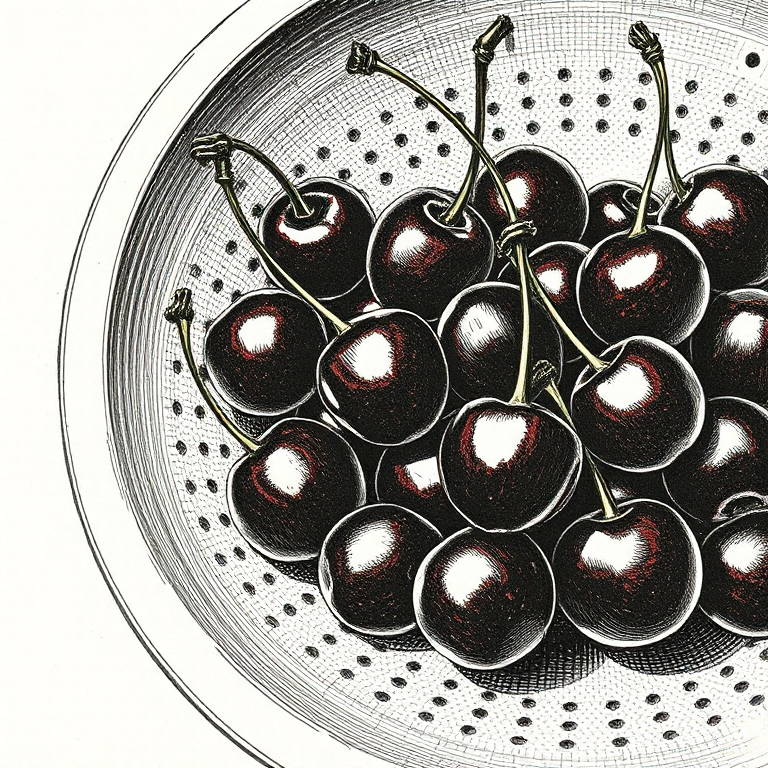
Frozen cherries make a better pie than they have any right to, as long as you respect the water. A 500g bag thaws to a heap of soft fruit sitting in a surprising amount of red juice, and if that juice goes into the pie raw you get a soup with a lid. So I thaw the cherries over a bowl, reduce the caught juice with the sugar to a syrup, slacken a little cornflour into it, and only then fold the fruit back through. The pastry is a plain all-butter pâte brisée double crust made the day before, the base blind-baked first so it sets crisp under the wet filling. Everything goes cold into a hot oven on a preheated tray, and the finished pie cools completely before it’s cut; that last bit is what turns a runny filling into a sliceable one.

Yield and time
- Makes: one 23cm pie, serves 8
- Hands-on: 45 minutes, split across two days
- Total: pastry and a fridge rest the day before; on the day, about 1.5 hours of oven time (the base is par-baked before the pie is filled) plus a long cool (at least 4 hours before cutting, overnight is better)
Ingredients
The pastry
- 1 batch pâte brisée (the full double-crust quantity, two discs), made the day before with the sugar (it’s a sweet pie)
The filling
- 1kg frozen pitted cherries (two 500g bags from Woolworths)
- 150g caster sugar
- 45g cornflour
- 2 tablespoons lemon juice
- ¼ teaspoon almond extract
- ¼ teaspoon fine salt
- 20g cold unsalted butter, cut into small cubes
To finish
- 1 egg, beaten with a splash of milk
- 1 tablespoon demerara or other coarse sugar
You’ll need a 23cm metal pie dish or tin (metal conducts better than ceramic and is what sets the base), a heavy baking tray or pizza steel to preheat the oven floor, and baking parchment and a jar of baking beans (or rice, or dried beans) for par-baking the base.
The day before: pastry
Make a batch of pâte brisée, the full double-crust quantity, divided into two discs with one a touch larger than the other (the larger one is the base). Make it with the 2 teaspoons of sugar from that recipe; this is a sweet pie, and the sugar against the well-salted dough is what stops the crust tasting flat next to the fruit. Wrap both and rest them in the fridge for at least 2 hours, ideally overnight.
The day before, or the morning of: the cherries
This is the step that decides whether the pie slices or runs.
Tip the 1kg frozen cherries into a colander set over a bowl. Leave them to thaw at room temperature for 2-3 hours, or in the fridge overnight, tossing once or twice. They’ll shed a lot of dark red juice into the bowl; that’s exactly what you want out of the fruit and into the pan.
When the cherries are fully thawed, give the colander a gentle shake and let them drain another ten minutes. You should have somewhere around 250-350ml of juice in the bowl.
Pour the caught juice into a small saucepan with the 150g sugar and the 2 tablespoons lemon juice. Bring to a boil and let it bubble down for 5-8 minutes until it’s reduced by roughly half and looks syrupy and glossy. In a small cup, slake the 45g cornflour with 3 tablespoons of cold water into a smooth slurry. Pull the syrup off the heat, whisk in the slurry, then return to a gentle heat and stir for a minute until it thickens to a thick, clear, pourable gel. Take it off the heat, stir in the ¼ teaspoon almond extract and ¼ teaspoon salt.
Fold the drained cherries through the warm gel. Don’t cook them; the residual heat is plenty. Let the filling cool to at least room temperature before it goes anywhere near pastry. A warm filling melts the butter in the base and you lose the flake. I usually spread it on a tray to cool faster, or stash it in the fridge.
Roll and line the base
Roll the larger disc out on a lightly floured bench to a circle about 4mm thick and 30cm across. Roll it up over the pin and unroll it into the 23cm dish, easing it down into the corners without stretching. Leave the overhang for now. Prick the base all over with a fork, then chill it in the fridge for 15 minutes while the oven heats; a cold, docked base blisters less and holds its shape.
Par-bake the base
A wet fruit filling is the enemy of a crisp bottom, so the base bakes on its own first, this is the step the earlier version skipped. Heat the oven to 200°C fan with the heavy tray or steel on a low shelf, and get it properly hot, a good 20 minutes.
Line the chilled base with a sheet of baking parchment and fill it with baking beans, pushing them up against the sides so the walls don’t slump. Set the dish on the hot tray and bake for 15 minutes, until the rim is set and pale. Lift out the parchment and beans, brush the base and sides with a thin layer of the beaten egg, and return it for 5-7 minutes, until the base is dry, set, and just colouring. The egg bakes into a seal that waterproofs the base against the filling. Cool it while you roll the lid; the filling must go into a cool base, not a hot one.
Fill and top
Roll the second disc to the same thickness. For a full lid, leave it whole; for a lattice, cut it into 2cm strips with a knife or a wheel. Either works, a lattice lets more steam escape and shows off the colour, a full lid keeps more juice in but needs generous vents.
Trim the par-baked base level with the rim of the dish. Tip in the cooled cherry filling and level it, it should mound a little above the rim. Dot the 20g cubed butter over the top.
Brush the baked rim with a little of the beaten egg. Lay the lid or weave the lattice over the fruit. Press it down onto the rim, trim the overhang to about 1.5cm, tuck it under against the edge of the dish, and crimp all the way round with your fingers or a fork to seal. If you went with a full lid, cut four or five steam vents in the centre with a sharp knife. Back into the fridge for 20-30 minutes while you bring the oven back up, a cold pie holds its shape and the lid sets before the butter melts.
Bake
Bring the oven and the tray or steel back to 200°C fan on the low shelf. Brush the top of the cold pie all over with the beaten egg and scatter the 1 tablespoon demerara across it.
Set the pie on the hot tray on the low shelf. Bake at 200°C fan for 25 minutes, until the lid is set and colouring. Drop the oven to 180°C fan and bake another 35-45 minutes. It’s done when the crust is deep gold all over and you can see the cherry juices bubbling up thickly through the vents or lattice gaps, not just simmering, but slow glossy bubbles. That bubbling is the cornflour reaching temperature and setting; pull it too early and the middle stays loose. With the base already par-baked you can push the colour further than you’d dare on a raw-bottomed pie, and the low shelf keeps the bottom heat where it’s needed, that’s what gets the pastry cooked through rather than pale and doughy. If the rim or lid browns faster than the centre, lay a ring of foil over the top.
The cool, don’t skip it
Lift the pie onto a wire rack and leave it completely alone until it’s cool. At least 4 hours; overnight is better. This is not patience for its own sake, the filling is a hot gel, and it only sets to a sliceable consistency as it comes down to room temperature. Cut into it warm and the cherries slump out in a red tide. Cut into it cold and you get clean wedges with the fruit standing up in the slice.
To serve
Just warm or at room temperature, with cold pouring cream, vanilla ice cream, or custard. If you want it warm, cool it fully first, then reheat the whole pie in a 160°C fan oven for 15 minutes, that way it sets and then warms, rather than never setting at all.
Storage
Covered at room temperature for two days, or in the fridge for up to four. The base is best on day one; after that, a few minutes in a hot oven crisps it back up. It also freezes well baked, wrap whole or in slices, thaw, and re-crisp in a moderate oven.