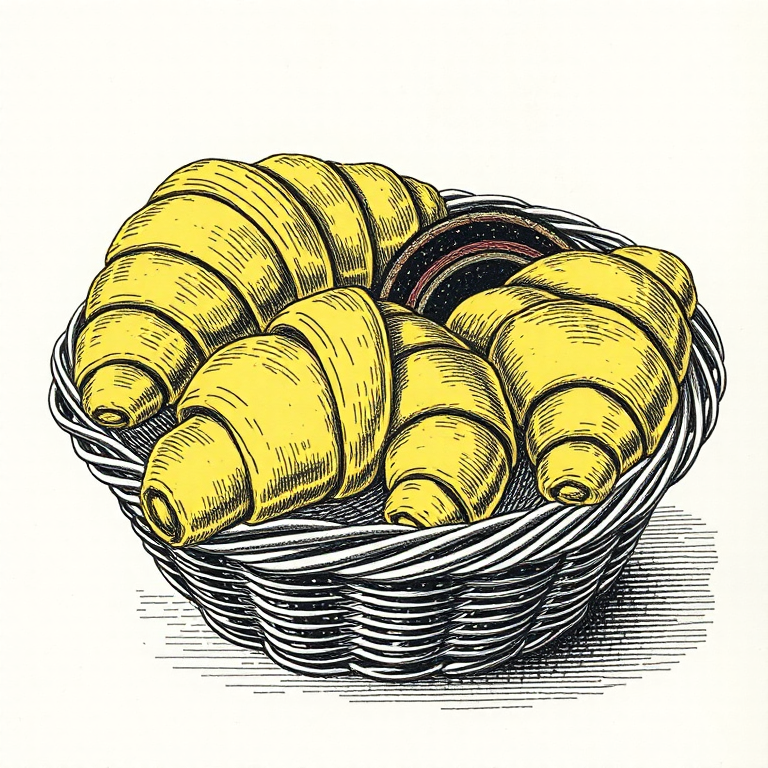
A real croissant dough has yeast in it, which is what separates it from rough puff. The détrempeThe yeasted dough that wraps the butter in a laminated pastry – flour, milk, sugar, salt, yeast, a little soft butter, mixed and rested before the butter block joins it. ferments slowly in the fridge while you sleep; the beurrageThe flat slab of cold butter folded into the détrempe during lamination – typically half the weight of the dough it’s wrapped in. gets folded in through the laminationFolding a butter slab into a dough through repeated rolls and folds, building hundreds of thin alternating layers that puff in the oven. ; the proof at warm room temp gives the lift. Skip any one of those and you’ve baked something else. The bonus side of doing it properly is that the shaped pastries freeze beautifully, a Sunday afternoon’s work buys four weeks of Monday breakfasts, one out of the freezer at a time, nine hours overnight in a cool kitchen, and a hot oven at 6am while the coffee brews.
Yield and time
- Makes: 24 pastries, 12 croissants and 12 pain au chocolat
- Hands-on: 3 hours
- Total: Friday evening to Monday morning, three calendar days, plus 9 hours overnight proof for each batch you bake
Ingredients
The détrempe
- 1kg strong bread flour
- 20g fine salt
- 100g caster sugar
- 14g instant dried yeast
- 580g cold whole milk
- 50g unsalted butter, soft
The beurrage
- 500g unsalted butter, cold but pliable, a high-fat European-style butter holds up to lamination better than supermarket own-brand
For the pain au chocolat
- 24 chocolate batons (70% dark, about 8cm long and 1cm square)
To finish
- 1 large egg, beaten with a teaspoon of water and a pinch of salt
You’ll need a stand mixer with a dough hook, a rolling pin, a long ruler or tape measure, two sheets of baking parchment cut to roughly 40cm × 40cm, a sharp knife, two large flat-bottomed freezer-safe trays, and freezer bags big enough to hold the lot.
Friday evening: mix and shape the butter
Tip the 1kg flour, 20g salt, 100g sugar, and 14g yeast into the mixer bowl and whisk through. Pour in the 580g cold milk and the 50g soft butter and mix on low for two minutes, then medium for four to five, until the dough comes together into a smooth ball that’s slightly tacky to the touch but doesn’t stick to your hand.
Shape into a 25cm square, wrap, into the fridge overnight.
While the détrempe rests, shape the butter. Cut the 500g cold butter into 1cm-thick slices and lay them in a 25cm square between two sheets of parchment. Beat with the rolling pin until the slices fuse, then roll smooth into an even 25cm × 25cm slab. Wrap, into the fridge.
Saturday: three single turns
Pull both blocks from the fridge twenty minutes before you start. They want to be cold but bendy, not fridge-stiff, if the butter cracks when you fold it, it’s too cold; if it smears, too warm. Aim for the texture of cold plasticine.
Roll the détrempe to a 50cm × 25cm rectangle, the long edge facing you. Lay the butter block on one half, fold the other half over, and pinch the seams closed, a clean parcel with no butter visible at the edges.
Turn one. Roll the parcel out long, away from you, into a 60cm × 25cm rectangle. Brush off any loose flour. Fold the bottom third up and the top third down like a letter into an envelope. Rotate 90 degrees so the folded edges sit on your left and right and the open layered edges face you and away. Wrap, into the fridge for thirty minutes.
Turn two. Roll out long again, letter foldFolding a rolled-out laminated dough in thirds, bottom-up and top-down like a letter into an envelope – one turn, multiplying the layer count by three. , rotate, wrap. Fridge for thirty minutes.
Turn three. Roll out long again, letter fold, rotate, wrap. This time rest the wrapped block in the fridge overnight.
Sunday: shape and freeze
Take the rested block out of the fridge and let it sit on the bench for ten minutes before rolling.
Halve the block lengthwise with a sharp knife. Put one half back in the fridge while you work on the other. Each half makes one tray of pastries.
Roll the first half on a lightly floured bench to a rectangle 80cm × 25cm, about 3-4mm thick, the long edge facing you. Trim the edges square so the lamination shows clean at the cut faces.
Aim for an isosceles triangle, base 10cm, height 25cm. Lay them out alternating point-up and point-down so they tessellate along the strip with no waste between. You’ll get six pairs from an 80cm strip, which is twelve triangles.
To shape: cut a tiny 1cm notch in the middle of each triangle’s base. Stretch the tip gently away from the base with both hands, you want the triangle a touch longer than its cut shape, maybe 28cm tip-to-base. Roll from the notched base toward the tip, with the notch opening up as you roll. Keep the tip tucked underneath so it doesn’t lift in the oven. Lay seam-down on a parchment-lined tray, curving the two ends inward into a deep crescent.
Roll the second half to 80cm × 24cm, 3-4mm thick. Trim the edges. Cut twelve rectangles, 8cm wide × 16cm long. Lay one chocolate baton across the rectangle about 2cm in from the short edge, roll once to cover, lay the second baton against the rolled edge, finish rolling. Lay seam-down on a second parchment-lined tray.
You should now have twelve croissants on one tray and twelve pain au chocolat on another. Slide both straight into the freezer, uncovered. Once they’re rock solid, two hours minimum, longer is fine, transfer them off the parchment into freezer bags. Squeeze out the air, label with the date, back into the freezer.
Sunday night: pull one out
Decide on Sunday evening how many pastries Monday morning needs. Take them out of the freezer at 9pm, lay them spaced on a parchment-lined tray, cover loosely with a clean tea towel, and leave them in a cool kitchen overnight. Nine hours at 14-18°C gives the dough what it needs: two or three hours to thaw, then six hours of slow proof. By 6am they’re ready.
Monday morning, 6am: bake
The pastries should look puffed and visibly jiggly when you nudge the tray. The layered edges have started to lift away from each other; the surface looks soft, not taut.
Heat the oven to 200°C fan.
Brush each pastry lightly with egg wash, paying attention to the surface rather than the cut edges.
Bake for 16 to 18 minutes until deep mahogany, not just gold. Rotate the tray once at the eight-minute mark if your oven is uneven.
Out of the oven, onto a wire rack for five minutes. Coffee should be brewing by then. Eat warm.
Storage and freezer life
The frozen shaped pastries hold their rise for about four weeks in a sealed bag. Past that, the yeast slows and the proof takes longer or never quite arrives, date the bag.
Baked croissants keep one day at room temp under a tea towel, then go stale. Re-warm a day-old croissant at 160°C fan for four minutes and it’s most of the way back.
Don’t refreeze a croissant once it’s been thawed and proofed.