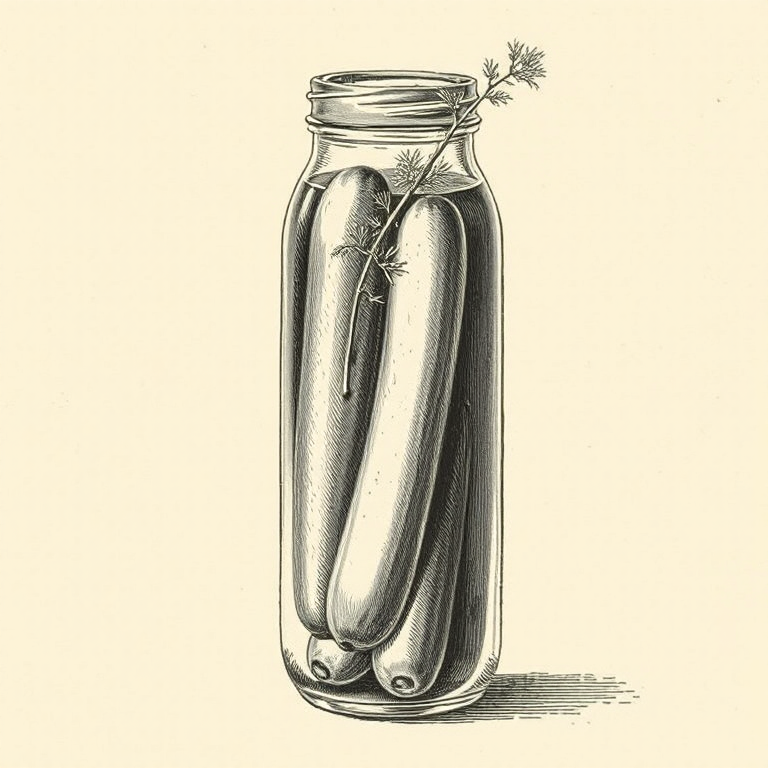
A refrigerator dill is not a lactofermented dill, and the distinction matters once. Lacto-pickles are alive: cucumbers in salt brine, fermented at room temperature for one to three weeks until the lactobacillus has eaten the sugars and dropped the pH below 4.0. They’re funkier, more complex, and the texture goes glassy in a specific way. Refrigerator dills are vinegar pickles: cucumbers in a hot vinegar-and-salt brine, cooled, into the fridge, no fermentation, three to five days minimum before they’ve taken on the dill and the garlic, and a month of fridge life. They’re crunchier, sharper, and the timing fits a week instead of three. For burgers, the refrigerator version is the right tool.

Yield and time
- Makes: one 1L jar
- Hands-on: 15 minutes
- Total: 3 to 5 days in the fridge before they’re ready; a week is the sweet spot
Ingredients
- 600-700g pickling cucumbers
- 4 dill heads
- 4 cloves garlic, peeled and lightly smashed with the side of a knife
- 1 teaspoon black peppercorns
- 1 teaspoon yellow mustard seeds
- 1 teaspoon coriander seeds
- 1 bay leaf
The brine
- 250ml white vinegar (5% acidity)
- 250ml water
- 25g pure salt (non-iodised)
- 25g caster sugar
Wednesday evening: pack and pour
Wash the 600-700g cucumbers. Trim 5mm off the blossom end of each one. Slice into 5mm rounds.
Sterilise the jar and its lid: pour boiling water through them, leave inverted on a clean tea towel until you’re ready to pack.
Layer the 4 dill heads, 4 smashed garlic cloves, 1 teaspoon peppercorns, 1 teaspoon mustard seeds, 1 teaspoon coriander seeds, and the bay leaf among the cucumber slices as you pack the jar. Pack firmly. Leave 2cm of headspace.
Bring the 250ml vinegar, 250ml water, 25g salt, and 25g sugar to a simmer in a small saucepan, stirring until the salt and sugar have dissolved. Don’t boil hard. Pour the hot brine over the cucumbers, filling the jar to within 1cm of the rim. Tap the jar gently on the bench to release trapped air bubbles. If any cucumber tops poke above the brine, push them down with a clean spoon.
Lid on, leave on the bench until the jar is cool to the touch (about 90 minutes), then into the fridge.
The wait
Three days minimum. Five is better. A week is the sweet spot: the cucumbers have taken on the dill and garlic properly, the chilli’s heat has bloomed through the brine, and the crunch is still there.
After three to four weeks they start to soften slightly. They’re still good for a month past that, just not as snappy. The brine itself stays useful indefinitely: a tablespoon goes into the burger sauce, more goes into salad dressings.
What goes wrong
Soft pickles are almost always one of three things: the blossom ends weren’t trimmed, the cucumbers were old (look for firm with no give when squeezed), or the brine was poured boiling rather than just simmering. The blossom-end trim is the highest-leverage step.
Cloudy brine comes from iodised salt, garlic releasing its sulphur compounds (harmless, drink the brine anyway), or genuine spoilage (smells off, lid is bulged; bin it). Some clouding is normal after a week and is no cause for concern.
Bitter pickles mean too much dried chilli or peppercorns. Pull the chilli out after four days if it’s drifted hot.
For burgers specifically
Slice the discs thin (2-3mm) with a sharp knife or a mandoline. Four to five thin slices on a burger lay flat against the patty without rolling around or sliding out. A single thick disc looks impressive but bites whole and falls out on the first chew. Thin and many is the move.
Used in the burger from scratch weekend.