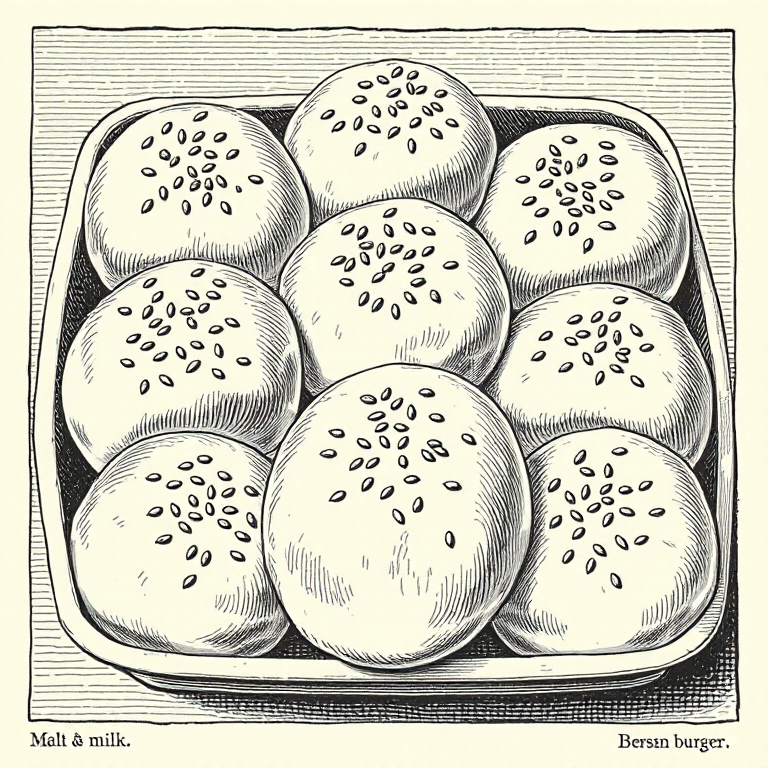
The standard supermarket burger bun is a disappointment because it’s been built dry. Tangzhong fixes that. A small pre-cooked roux of flour and milk pre-gelatinises some of the starch before the dough’s mixed, which lets the rest of the loaf carry more water than it could otherwise hold. The crumb that comes out is pillowy, faintly sweet, and stays soft on day two. The build is overnight: mix Saturday morning, shape and cold-prove overnight in the fridge, warm-prove and bake Sunday morning while the smoker comes up to temperature.

Yield and time
- Makes: 8 rolls, about 130g each
- Hands-on: 45 minutes
- Total: Saturday morning mix to Sunday morning bake, about 20 hours including the overnight cold prove
Ingredients
The tangzhong
- 25g strong bread flour
- 125g whole milk
The dough
- 475g strong bread flour
- 70g caster sugar
- 8g fine salt
- 7g instant dried yeast
- 1 large egg (about 50g out of shell)
- 220g whole milk, room temperature
- 60g unsalted butter, softened
- All of the cooled tangzhong
To finish
- 1 egg beaten with a teaspoon of milk and a pinch of salt
Saturday morning: tangzhong, dough, bulk prove
Whisk the 25g flour and 125g milk together in a small saucepan until smooth. Over medium-low heat, stir constantly with a silicone spatula. After two or three minutes it will thicken suddenly into a glossy paste. The moment you can see the spatula’s track across the bottom of the pan and the paste reads 65°C on a thermometer, pull it off. Scrape into a small bowl, press cling film against the surface, leave to cool to lukewarm.
In a stand mixer with the dough hook, combine the 475g flour, 70g sugar, 8g salt, and 7g yeast. Add the egg (1 large, about 50g out of shell), the 220g milk, and the cooled tangzhong. Mix on low for two minutes to bring together, then medium for four minutes. Add the 60g softened butter a third at a time, letting each addition incorporate before adding the next. Once all the butter is in, mix on medium-high for another six to eight minutes until the dough is smooth, glossy, and pulls cleanly from the sides of the bowl. The windowpane test should give a thin translucent membrane that holds without tearing.
Round into a ball, into a lightly oiled bowl, cover, prove at room temperature for 60 to 90 minutes until roughly doubled.
Saturday afternoon: shape and cold prove
Tip out onto a lightly floured bench. Divide into 8 pieces of about 130g each (use scales).
Shape each piece into a tight round: cup the dough under your palm, drag it in small circles against the bench so the surface pulls taut while the seam underneath stays sealed. Place on a parchment-lined tray with about 3cm between rolls; they want to grow into each other slightly in the final prove.
Cover the tray loosely with cling film, into the fridge for 12 to 18 hours.
Sunday morning: warm prove and bake
Pull the tray out of the fridge at 8am. Leave covered on the bench for 90 minutes to two hours. The rolls should puff visibly, and a gentle press with a floured finger should spring back slowly, leaving a faint impression.
Heat the oven to 180°C fan.
Brush each roll lightly with egg wash, paying attention to the lid but not the cut between rolls.
Bake on the middle shelf for 18 to 22 minutes, until the tops are deep mahogany and the bottoms sound hollow when tapped. Internal temperature in the centre of a roll should be 92-94°C.
Onto a wire rack to cool. Resist cutting them open until they’re at room temperature. A hot tangzhong roll is gummy in the middle.
Storage
The rolls keep two days at room temperature in a sealed bag or under a tea towel. Past that, slice and freeze.
For burgers specifically
Slice horizontally with a serrated knife. Toast the cut faces cut-side down on a hot dry skillet for thirty seconds.
Used in the burger from scratch weekend.