
Two hundred subscribers took longer than anyone expected and more rework than anyone wants to admit, but the number is real. Maya secured the next funding round on the back of it, and the board’s new target came with the money: 1,000 active subscribers within six months. Five times the current base in half a year.
Maya tells herself this on the coastal track at 5:45am on Monday, feet landing on packed sand, breath steady. Two hundred people paying real money every week for a box of local produce. She’s proved something. She should feel good about it. But the board call last Thursday sits in her chest like a stone she swallowed. The new target isn’t a vote of confidence; it’s a test. Angela had said it kindly enough, “We’re excited about the trajectory, Maya”, but the slide behind Angela’s head had a red line showing where the funding ran out if they didn’t hit it.
She showers, makes coffee, sits at the kitchen table with her laptop. Nadia is still asleep. The photo of her parents’ farm catches the morning light: her father standing in front of the converted dairy shed, smiling but tired. She knows that look. It’s the face of someone who believes in what they’re building but can’t yet see how it survives.
She opens the subscriber dashboard. Two hundred and six. Net gain of three last week.
Three.
But there’s a problem hiding in the numbers.
The churn problem
Churn is 8% monthly. For every ten new subscribers the team signs up, they lose three or four existing ones.
Sam walks the team through it on Monday morning. “We added forty-two new subscribers last month. We lost sixteen. Net gain: twenty-six. If we keep losing sixteen a month, we need to sign up sixty a month just to net the growth we need.”
Maya does the maths on the whiteboard. Sam’s number assumes the sixteen-a-month loss stays flat. It won’t. Churn is a percentage, not a count: 8% of 200 is sixteen, but 8% of 400 is thirty-two, and 8% of 600 is forty-eight. The bigger the base, the more they have to replace before they grow at all. At 8% monthly churn, even doubling their acquisition rate would only get them to around 600 subscribers in six months. They’d never hit 1,000 on acquisition alone; they had to bring churn down too.
“We need to understand why people leave,” Maya says.
Tom nods. “Let’s Event Storm it.”
The wrong tool for the job
The team books the meeting room, grabs the sticky notes, and starts mapping the cancellation flow. After an hour, the wall has a clean timeline of what happens when someone cancels. The process is well mapped.
Lee has been quiet, which is unusual. “This is a good map of the cancellation process,” he says. “But you’re mapping what happens when they leave. Not why they decided to leave. Those are different questions.”
He’s correct. The map says nothing about why subscribers decided to cancel in the first place. That motivation lives outside the system, in the customer’s kitchen on a Tuesday evening, in the moment they decide this subscription isn’t worth it any more.
Tom is frustrated. “So we wasted an hour?”
“Not wasted. You now have a clean map of the cancellation flow, which you’ll need when you build retention features. But you need a different lens for the why.”
Jobs to Be Done
Lee draws a simple diagram on the whiteboard. A stick figure, an arrow, and a box labelled “Greenbox.”
“Clayton Christensen’s framework. The core idea: customers don’t buy products. They hire them to do a job in their life. Your product isn’t competing with other produce boxes; it’s competing with whatever else the customer could hire to do the same job.”
“Isn’t the job obvious?” Priya says. “They want fresh local vegetables.”
“Maybe. But if that were the job, they could go to a farmers’ market. Or join a food co-op. What does Greenbox do that those alternatives don’t?”
Nobody answers immediately. It’s a harder question than it sounds.
Lee tells them about Christensen’s milkshake study: a fast-food chain that couldn’t sell more milkshakes until they watched what actually happened at the counter. Half the milkshakes were sold before 8am, to commuters. The job wasn’t “enjoy a delicious milkshake.” The job was “make my commute less tedious.” Once they understood that, they made the milkshake thicker and added fruit. Sales went up 40%.
“Greenbox isn’t competing with other produce boxes. It’s competing with whatever else your customers could do to solve the same problem in their lives.”
Talking to actual humans
Lee suggests interviews. Not surveys, not analytics. Actual conversations with actual people.
“Three groups. Five active subscribers, five who cancelled, five who considered subscribing but didn’t. Thirty minutes each. The hard part isn’t the time; it’s asking the correct questions. And the first rule, the one everyone breaks: don’t defend. Whatever they say about the product, don’t explain, don’t correct, don’t apologise mid-sentence. Just listen and ask the next question. The moment you start defending, the conversation closes.”
The other rules: Don’t ask “why do you subscribe?”: people will rationalise. Ask about the timeline: “Walk me through the moment you decided to sign up.” Don’t ask “what features would you like?”: people will invent features they’d never use. Ask about struggles: “Tell me about the last time you were frustrated with dinner.” Listen for the switch: the moment someone moved from their old solution to Greenbox.
Maya records each interview on her phone. They use an LLM to transcribe the recordings and identify recurring themes across transcripts, faster than a human reader because it can hold five long conversations in context simultaneously. But Maya reads every transcript herself.
The interviews are harder than anyone expected. The first two feel stilted. Maya keeps asking leading questions. By the third interview, things go properly sideways.
His name is Greg. He cancelled six weeks ago. He arrives at the cafe ten minutes late, already irritated.
“Walk me through the moment you decided to sign up.”
“I’ll tell you what was happening. My wife found you on Instagram and signed us up without asking me. Then I was the one dealing with the box every week.”
“And what was the experience like?”
“Terrible. You sent me beetroot three weeks running. Three weeks. I told your support team after the second time. The third week I opened the box and there it was again. Purple. Staring at me.”
Maya feels heat rise in her neck. “We track all dietary preferences and –”
“No you don’t.” Greg puts down his coffee. “Or if you do, your system is broken. I sent two emails. Nobody responded to the second one.”
“I’m sorry about that. We’ve improved our –”
“I’m not here for an apology. You asked to talk. I’m talking. You want to know why I left? I spent more money on your box than I would have at a Hartland Group supermarket and I got ingredients I didn’t want that nobody helped me cook. I switched to Freshly. Seven dollars cheaper and the delivery tracking is better.”
Maya blinks. “Freshly?”
“Yeah. The Sydney mob. They launched in Perth last month. The produce isn’t as good but at least I know what I’m getting.”
Maya writes down “Freshly” on her notepad and underlines it twice.
“Look, I could tell you cared. The little notes about which farm the carrots came from, that was nice. But nice doesn’t matter when I’m standing in my kitchen at six o’clock with a kohlrabi and no bloody idea what to do with it.”
The interview ends after twenty minutes. Greg shakes her hand and leaves. Maya sits at the cafe table, staring at her notepad. Lee, who’d been observing from the next table, walks over.
“That was rough.”
“He was rude.”
“He was honest. And you broke the first rule; you got defensive. The moment he said the system was broken, you stopped listening and started defending.”
“Because what he said wasn’t true. We do track preferences.”
“Do you track his preference? Did anyone action his emails?”
Maya opens her laptop and searches the support inbox. Greg’s first email: Sam had responded with a template. The second email, four days later, has no reply. It sits unread between forty other messages.
“We missed it,” Maya says quietly.
“That was the most useful twenty minutes of the whole batch. Greg gave you a system failure, a competitor name, and the clearest articulation of the core problem anyone’s said yet. ‘Standing in my kitchen at six o’clock with a kohlrabi and no idea what to do with it.’ That’s your answer. And you almost missed it because you were defending instead of listening.”
Maya nods slowly. She writes down Greg’s kohlrabi line and circles it.
That evening, she goes home and searches for Freshly. A polished website. A slick app with real-time delivery tracking. AUD$18 per week. An Instagram with sixty thousand followers. A twelve-million-dollar Series A.
Nadia comes in from a late physio session and finds Maya at the kitchen table, laptop open to Freshly’s website, a glass of wine untouched.
“What’s that?”
“Competition. Well-funded competition.”
Nadia looks at the screen. “Their boxes look nice.”
“They’re not local. They buy wholesale from the markets.”
“Does that matter?”
Maya doesn’t answer. At midnight, Nadia finds her in the kitchen, reorganising the cupboards. Tins arranged by expiry date. Spices alphabetised. The jars of preserved lemons that Maya’s mother sent from Margaret River lined up like soldiers.
Nadia leans against the doorframe. “You’re doing the cupboard thing.”
“I’m fine.”
“You’re alphabetising cumin at midnight. You’re not fine.”
Maya puts down the jar. “The customers don’t care about local sourcing, Nadia. We interviewed fifteen people. Three of them mentioned local as the main reason they subscribe. I built the whole brand around it. The fifty-kilometre promise, the farm stories, all of it. They don’t care.”
“They care about something, though?”
“Convenience. They care about not having to think about dinner. That’s it. That’s the product.”
“Is that a bad thing?”
“It’s a different thing. It’s a completely different business than the one I thought I was building.”
Nadia sits down. “You built the brand around what matters to you. Now you’re finding out what matters to them. Those can both be true.”
Maya looks at the preserved lemons. Her mother made them last summer, in the kitchen of the small house in Margaret River. The recipe is her grandmother’s, from Taiwan. Three generations of women preserving food with their hands.
“I know,” Maya says. “I just need a minute.”
She calls her mum the next morning, before the coastal run.
“Mum, did it bother Dad that people didn’t care about where their food came from? When you were farming?”
Her mother laughs. “Your father didn’t farm because people cared about farming. He farmed because people needed to eat. The caring was his. The eating was theirs.”
Maya stands at the kitchen window watching the sky lighten over Fremantle. Her mother’s words land somewhere deep.
By the fourth interview, Maya finds her rhythm. She learns to sit with silence, the pauses where the interviewee is actually thinking. Those pauses produce the most honest answers.
One churned subscriber, a man named Patrick, gives them a fifteen-minute story about his Tuesday evenings that becomes the team’s touchstone. He describes getting home at six, opening the Greenbox, seeing ingredients he doesn’t recognise, googling recipes while his kids argue about homework, giving up, ordering pizza, and then feeling guilty about the AUD$25 box of vegetables wilting on the counter. “I was paying twenty-five dollars a week to feel bad about myself.” That sentence ends up on a sticky note in the office.
What the interviews reveal
Three days later, the team has fifteen transcripts and a wall of quotes. The room goes quiet.
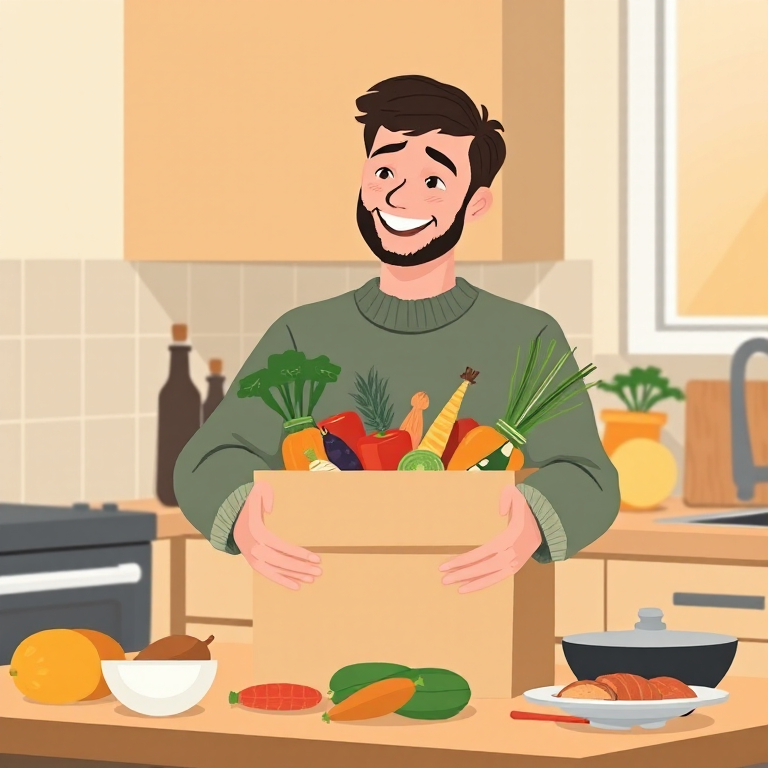
Active subscribers barely mention vegetables. They mention relief.
“I don’t have to think about what to cook on Tuesday. The box arrives and dinner is decided.”
“It’s one less thing to worry about. I get home, I open the box, and I know what we’re eating.”
One active subscriber is Mrs Patterson, the same Mrs Patterson whose beetroot aversion Maya has been carrying in her head since the Example Mapping sessions. She’s 63, lives alone on Stirling Highway, subscribed since the second week of the pilot.
“I just open the box and trust what’s inside,” she says. “Except when there’s beetroot.” She smiles. “I don’t even know what’s in the box most weeks. I just know I don’t have to think about it.”
Jas is sitting in on this interview. She’s in the corner with her Moleskine open. When Mrs Patterson says “dinner is decided,” Jas sketches a quick napkin-style drawing: a box opening, a recipe card visible on top, and underneath the words dinner decided. She underlines it. Then she underlines it again.
The job isn’t “get fresh local produce”; it’s “eliminate the mental load of deciding what to cook.” The produce is the mechanism; the stress relief is the product.
Churned subscribers tell a starkly different story.
“The vegetables were great but I’d open the box and have no idea what to do with half of it.”
“It actually added stress instead of removing it. I had all these beautiful vegetables and the guilt of not knowing how to use them before they went off.”
The box didn’t do the job. The mental load wasn’t reduced; it was relocated. “What should I buy?” became “What on earth do I do with this?”
Two of the five churned subscribers mentioned Freshly by name. Greg wasn’t the only defection. Louise said: “I tried that Freshly thing. It’s not as nice, but it’s easier.” Easier, not better. Easier.
People who considered but didn’t subscribe rejected the uncertainty, not the product.
“I looked at the website and I couldn’t tell what I’d actually get.”
“I was interested but my partner was sceptical. I couldn’t explain what we’d be getting.”
One non-subscriber, Clare, put it perfectly: “I’m already drowning in decisions. I didn’t want to add another one. If I’d known exactly what was coming and what I could cook with it, I probably would have signed up.” She was describing the same job from the outside looking in. The marketing communicated the mechanism (“local produce”) without the outcome (“dinner, sorted”).
The insight that changes everything
Maya stares at the quotes on the wall. Priya says it first.
“We’ve been marketing this as ‘fresh local vegetables.’ But that’s not why people stay. They stay because we solve Tuesday night. And they leave because we don’t solve Tuesday night; we just make it a different kind of hard.”
Tom leans forward. “So the next feature isn’t better substitution or more variety. It’s…”
“Recipe cards,” Jas says. She pulls out the Moleskine and opens it to the napkin sketch. “Simple, fast recipes that use exactly what’s in this week’s box. Open the box, pick a card, cook dinner. No thinking required.”
The room is energised in a way it hasn’t been for weeks. Not because recipe cards are exciting technology; they’re printed cards in a cardboard box. But they directly serve the job.
Priya pushes further. “Without them, we’re delivering ingredients. With them, we’re delivering dinner.”
“Greg’s kohlrabi problem,” Sam says.
“Exactly. He didn’t need better kohlrabi. He needed someone to tell him what to do with it in twenty minutes.”
Maya adds a constraint: “Every recipe has to be doable by someone who considers themselves a bad cook. If Patrick can make it, anyone can.”
The team isn’t designing a feature; they’re designing around a specific human being they’ve actually talked to. Patrick isn’t a persona on a slide deck; he’s a real person who told them about feeling guilty on a Tuesday evening.
Tom is quiet for a moment. “I was about to spend three weeks improving the substitution algorithm. But it doesn’t serve the job. A better substitution algorithm doesn’t reduce anyone’s dinner stress.”
Maya asks the LLM to help draft the first set of recipe cards. She pastes in this week’s box contents and asks for three simple recipes, each under thirty minutes, using only box contents plus basic pantry staples. The LLM produces them in seconds. Jas designs a card layout. Sam sends them to the printer.
Tom builds a prototype that afternoon: a simple script that takes the week’s box contents, sends them to an LLM with recipe constraints, and produces three formatted recipes. The whole pipeline, from box contents to print-ready cards, takes less than ten minutes per week. Without the LLM, it would require a food writer. With it, Maya reviews and approves the output in fifteen minutes.
When to use Jobs to Be Done
- When churn is high and you don’t know why. Exit surveys give surface reasons. JTBD interviews give the real reason: the job wasn’t being done.
- When you’re about to invest in a new feature. Does it serve the job customers are hiring you for? If not, you might be building the wrong thing.
- When acquisition is hard and you don’t know your message. “Fresh local vegetables” is a product description; “Stop stressing about Tuesday dinner” is a job statement. One converts better.
When not to use it
- When the problem is operational, not motivational. If subscribers leave because deliveries arrive late, fix logistics. JTBD is for understanding why customers hire and fire your product.
- When you already know the job. If the team has a clear, validated understanding of why customers buy, running more interviews is discovery theatre.
Back to Greenbox
Two weeks after the recipe cards ship, churn drops from 8% to 5.5%. Three of the five churned subscribers re-subscribe after Sam emails them. Patrick, the man with the Tuesday-night pizza guilt, signs back up the same day. Greg does not. Louise does not. Maya checked.
She also checked Freshly’s website again. They’ve added a Perth delivery zone. Launch date: next month. Twelve million dollars, a slick app, and AUD$18 per week. Maya’s small box costs AUD$25 and comes with a recipe card printed on a twelve-cent piece of cardboard.
The recipe cards are working. The churn is dropping. The direction is correct.
She doesn’t tell anyone that she spent twenty minutes on Freshly’s sign-up flow that evening, getting as far as the payment page, just to see what the experience felt like. It was smooth. It was fast. It was everything Greenbox’s sign-up flow isn’t. She closed the tab and went for a run on the coastal track, even though it was dark and Nadia told her the path wasn’t lit.
The path was fine. The run helped. The knot in her chest loosened by half a turn.
Next week, the team takes that insight and asks an uncomfortable question: what else do we believe about this business that we haven’t actually validated? That’s Assumption Mapping, and the answer is more than anyone wants to admit.