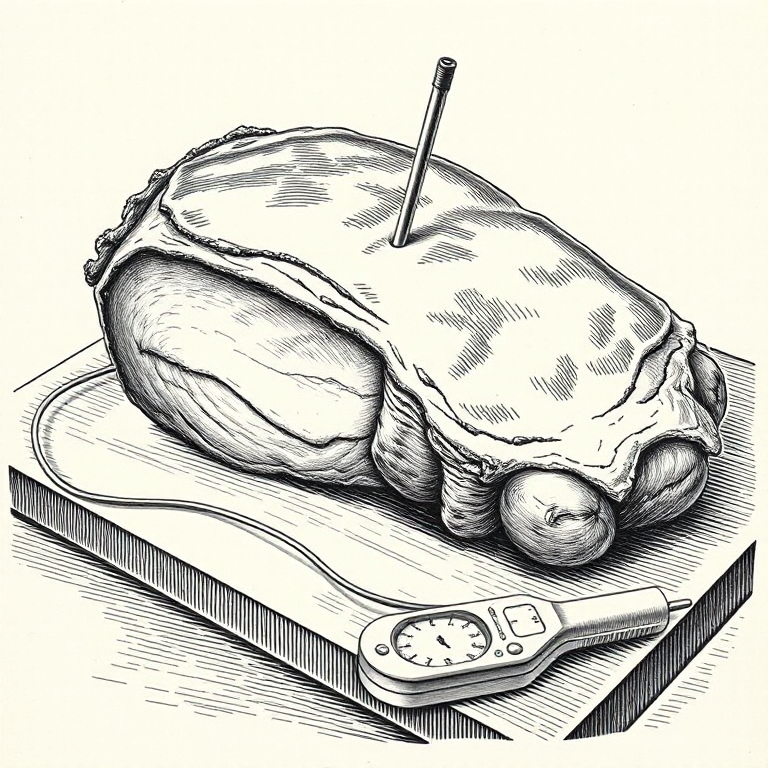
I own four kitchen thermometers, not because I’m a gadget person but because no one thermometer is good at all the different jobs, and the failure modes of using the wrong one make four specialist tools cheaper than one clever generalist.
A Meater, a slim wireless probe that lives inside a piece of meat for hours, broadcasting its core temperature to my phone while the smoker does its slow work. Set it, stick it in, close the lid, walk away until the phone tells me the brisket is through the stall.
An instant-read, a thin metal probe on a folding handle that reads the moment I open it. For steak, fish, chicken in the pan, a roast pulled from the oven to check the thickest part before resting. Stab, read, react.
A cabled probe for hot oil, heat-resistant cord with a probe at one end and a readout at the other. The probe lives in the pan; the readout sits on the counter at a safe distance. I watch the temperature rise, see the drop when food goes in, make sure it recovers before the next batch.
A sugar thermometer, clipped to the side of the pan with its tip in the syrup. Sugar work lives and dies at specific temperatures, soft ball at 118°C, hard crack at 154°C, caramel catching fire not much higher, and the margin between stages is four or five degrees.
None of these is a substitute for any of the others. You cannot run a twelve-hour brisket with an instant-read. You could, in theory, judge a steak with a Meater, but the probe is thick enough to leave a gaping hole. You could clip the sugar thermometer to the chip pan, but then you’re leaning over hot oil every time you want a reading.
This is a post about knowing what’s happening inside the thing you’re cooking. Most of it is about software.
The time-and-hope school of cooking
Most home cooks are taught to cook by time. Twenty minutes per kilogram plus twenty. Six minutes a side. Three minutes, flip, two, rest. Set a timer, trust the number, hope.
Sometimes this works. Often it produces overcooked chicken, or a pork shoulder dangerously undercooked in the middle, or a batch of caramel that went from amber to acrid black in the thirty seconds you spent answering the door.
Time is a proxy for the thing you actually care about, and a poor one. You care about the state, the internal temperature, whether the sugar has hit soft-ball, whether the oil has recovered. Time is loosely correlated with those things, under ideal conditions, for a particular quantity on a particular day. Change any of those and the correlation bends. A thermometer bypasses the proxy.
Four shapes of decision
I have four thermometers because there are four genuinely different shapes of decision in the cooking I do.
Instant-read is for quick decisions at a critical moment. Ninety seconds into searing a steak, you need to know right now whether to flip, rest, or give it another pass. Stab, read, react. Terrible at long cooks because you have to keep going back to the thing.
A cabled oil probe is for continuous monitoring of a single high-stakes system. Frying is dangerous and unforgiving. The oil needs to hold 175°C through the shock of each batch. Drop too far and the chips absorb oil; rise too high and you’re near the smoke point. The cable lets the instrument sit in the process while you stand at a safe distance.
A sugar thermometer is for precision work inside a narrow tolerance band. The stages are separated by four or five degrees, and miss by more and you’ve made something else entirely. An instant-read won’t keep up, and nothing else clips to the pan with its tip held in the syrup, reading continuously while both your hands are busy.
A smoker probe is for long, unattended monitoring over hours. Brisket takes hours and needs the lid closed. You cannot stand there stabbing every five minutes without wrecking the result. A wireless probe lets you set it, close the lid, walk away.
Four genuinely different categories of instrument, built around four genuinely different categories of decision.
The same four shapes in software
The same four shapes run through how you monitor running software.
Instant-read is the quick diagnostic. In an incident, you SSH in and run top, tail a log, curl an endpoint, grep the last five minutes of errors. Stab, read, react. Indispensable, and useless for anything longer than one human’s attention.
Cabled probes are the dedicated health check on a single dangerous component. A primary database’s latency graph on a screen someone watches during the deploy window. A queue-depth alert that pages when the backlog climbs. One specific thing, monitored continuously because it’s too hot to keep touching.
Sugar thermometers are the precision instruments for narrow-tolerance work. Latency SLOs where p99 has to stay under 300ms. Certificate expiry tracking where the difference between “fine” and “production is down” is measured in hours.
Smoker probes are the long-running unattended observability. Metrics exported every few seconds, traces on every request, structured logs shipped to a central store, alerts on specific thresholds. You don’t stand over the service; you instrument it properly and trust the instruments.
Mature teams have all four. Every team that tries to make one tool do all four jobs ends up doing at least two badly. The team with one giant dashboard that thinks it’s covered will find out, when the oil catches fire, that a dashboard is not the same as a dedicated monitor on the dangerous part.
Monitor the thing, not the clock
Teams that rely on time for confidence are doing what engineers do when they say “we haven’t had an incident in three weeks, we must be fine.” Three weeks is a proxy. What you actually care about is the state of the system, error rates, latency percentiles, queue depths, disk headroom, certificate expiries, the things silently accumulating toward a threshold nobody has been watching. None of that is in the number “three weeks.”
The clock has no idea whether your brisket is done, whether your oil is at frying temperature, or whether your production system is about to page somebody.
Adjust as you go
A thermometer only does its job if you act on what it tells you. The instrument is half the job. The other half is knowing what to do about it. A probe you don’t act on is just a small expensive anxiety. A dashboard nobody looks at is worse than no dashboard, because it leaves you believing you have observability when what you have is a graveyard of neglected numbers.
Read the number. Make a decision. Adjust. Then read again.
Three rules for the probe
- Use the correct tool for the shape of the decision. Quick sharp moment, continuous monitoring of one dangerous thing, precision inside a narrow band, long unattended observation, four different shapes, and one instrument cannot cover them all.
- Measure the thing you actually care about, not a proxy for it. Internal temperature, not clock time. Error rate, not deploys-since-incident. Oil temperature, not knob position.
- Read and respond. The instrument is half the job. Acting on what it tells you is the other half.
The brisket doesn’t care how long it’s been on the smoker; it cares about its core temperature. The production system doesn’t care how many days since the last deploy; it cares about its error rate, its latency, its queue depth, its memory headroom.
Cook with the correct probe. Engineer with the correct observability. In both kitchens, hope is not a strategy.