You glance at your phone, read the digits, and get on with your day. Behind those digits is a tower of compromises, conventions, and politics that has taken humanity thousands of years to build. The time it shows you is wobblier than you’d think.
Sticks in the ground
Timekeeping started the way most useful things start: someone needed to solve a practical problem.
If you’re growing crops, you need to know when to plant. If you’re a priest, you need to know when to perform a ritual. If you’re a trader, you need to know when the market opens. The sun moves across the sky in a predictable arc, so you stick a pole in the ground and watch its shadow. Congratulations: you’ve invented the sundial, and you’re roughly in agreement with everyone else in your village about when noon is.
The Egyptians were dividing daylight into twelve parts around 1500 BCE. The Babylonians gave us base-60 counting, which is why we’re stuck with 60 minutes in an hour and 60 seconds in a minute: a convention so old that nobody alive chose it, yet nobody can change it.
But sundials only work when the sun shines. So people got creative.
Water clocks, clepsydrae, from the Greek kleptein (to steal) and hydor (water), measured time by the regulated flow of water from one vessel to another. The ancient Egyptians used them by at least 1500 BCE, and versions appeared independently in China, Greece, and Rome. Some were remarkably sophisticated. The Chinese polymath Su Song built a water-powered astronomical clock tower in 1088 that stood ten metres tall and featured an escapement mechanism (a device for converting continuous water flow into regular, counted intervals) centuries before European clockmakers would independently develop the same idea (Joseph Needham, Science and Civilisation in China, Vol. 4, Part 2).
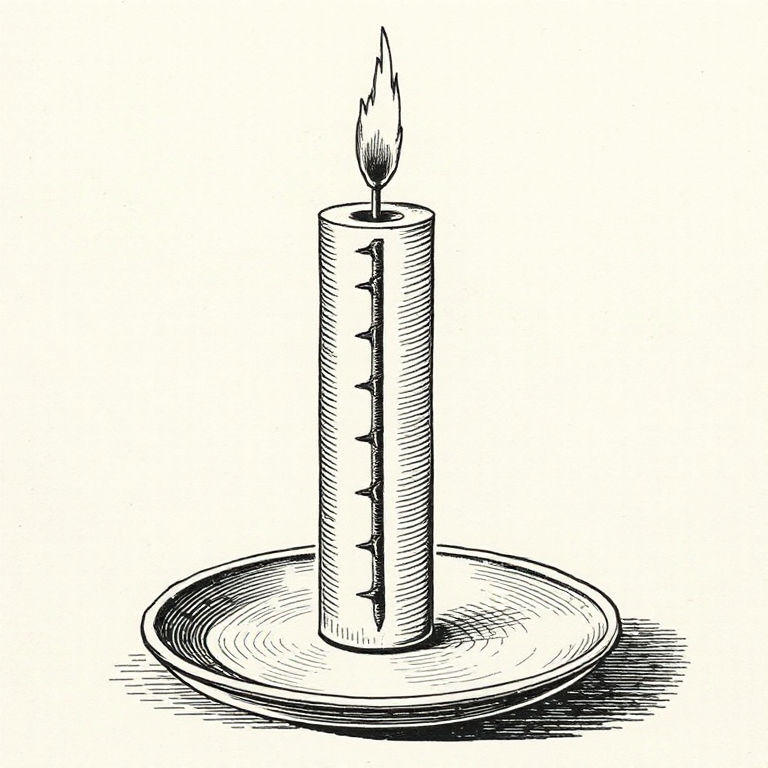
Candles as clocks were simpler but clever. You’d mark a candle at regular intervals and burn it down, reading the time from how much remained. King Alfred the Great is traditionally credited with using graduated candles to regulate his daily routine in the 9th century, though the story is likely embroidered. The ingenious trick was the candle alarm clock: push tacks or small nails into the wax at a specific height. When the candle burns down to that point, the tacks fall onto a metal plate below with a clatter. You’ve just been woken up by a piece of wax and some hardware.
Hourglasses, or sandglasses really, became widespread from the 14th century. Cheap, portable, and unaffected by weather. Ships used them to mark watches. Churches used them to time sermons (some congregations reportedly installed them facing the preacher, as a gentle hint). Kitchens used them, and still do. An hourglass doesn’t tell you what time it is; it tells you how much time has passed, which is often what you actually need.
Village clocks mattered more than any personal timepiece for most of human history. Before wristwatches, before pocket watches, the church or town clock was the time. Its bell rang the hours, and entire communities synchronised their days to one mechanism in one tower. If that clock drifted, everyone drifted with it, and nobody noticed because there was nothing else to compare it to. Time was communal, and it was local.
For most of human history, this was fine. Noon was when the sun was highest where you stood, and what noon meant three towns over was someone else’s problem.
Clockwork
The mechanical clock changed everything slowly, then all at once.
Weight-driven clocks with verge escapements (an early mechanism that converted the steady pull of a hanging weight into a regular tick-tock) appeared in European church towers in the late 13th and early 14th centuries. They were large, expensive, and not particularly accurate, drifting by perhaps fifteen minutes per day. But they worked at night, they worked in rain, and they kept the whole town on the same schedule.
Then Galileo noticed something. In 1583, as the story goes, he watched a lamp swinging in the Cathedral of Pisa and timed it against his pulse. Every swing took the same amount of time, regardless of how far the lamp swung. He’d stumbled on what physicists call isochronism: a pendulum’s swings take the same time regardless of how wide they are. He never built a pendulum clock himself.
Christiaan Huygens did. In 1656, the Dutch mathematician and physicist built the first working pendulum clock, and the leap in accuracy was extraordinary: from roughly fifteen minutes of drift per day to about fifteen seconds per day. That’s an improvement of roughly sixty-fold. Huygens patented the design the following year and published the theory in Horologium Oscillatorium (1673), one of the great works of 17th-century physics.
From there, the history of timekeeping is a history of progressive miniaturisation. Tower clocks became mantel clocks. Mantel clocks became pocket watches as mainsprings replaced hanging weights and balance wheels replaced pendulums (a pendulum, after all, needs gravity and a stable surface; useless in a trouser pocket). Pocket watches became wristwatches. Each step required new engineering: smaller parts, better lubricants, more precise machining. The craft of watchmaking drove precision manufacturing for centuries before the Industrial Revolution made it commonplace.
The problem that made time matter
In the 18th century, ships were sinking because sailors couldn’t figure out where they were. Not north-south; that part was easy. You measure the angle of the sun or the North Star above the horizon and you’ve got your latitude, your position north or south of the equator. Sailors had been doing this reliably for centuries.
The deadly question was east-west. Longitude, your position east or west of a reference point, was a different beast entirely, because longitude is fundamentally a time problem. The Earth rotates 360 degrees in 24 hours, which is 15 degrees per hour. If you know it’s noon where you are and you also know it’s currently 3:00 PM back at your reference point, you’re three hours west, 45 degrees of longitude. Simple arithmetic. And once you know your longitude, you combine it with your latitude (which you already have from the stars) and plot your position on a chart. From your position on a chart, you can see where the land is, where the rocks are, and whether you need to change course. Longitude turns “somewhere in the Atlantic” into a dot on a map.
The catch: you need to know what time it is somewhere else. And in the 18th century, no clock could survive months at sea. Pendulum clocks were hopeless on a rocking ship. Without a reliable way to carry a reference time, sailors relied on dead reckoning: estimating their position by tracking how far they’d travelled from a known starting point. Speed was measured with beautiful simplicity: throw a rope with knots tied at regular intervals off the stern, let it run through your hands, and count how many knots pay out in a set time. That’s why we still measure nautical speed in knots. Note your speed, note your compass heading, note how long you’ve been on that heading, and do the arithmetic. If you left Lisbon heading west at five knots for six hours, you’re roughly thirty nautical miles west of Lisbon.
The problem is that dead reckoning accumulates errors. Every estimate is slightly off: the current pushed you north, the wind shifted and nobody noticed for an hour, the speed measurement was wrong because the sea was rough. Each small error compounds on the last. After weeks at sea, a dead reckoning position could be off by hundreds of miles. And there was no way to check it, because checking required knowing your longitude, which required a clock.
On 22 October 1707, a fleet of Royal Navy warships under Admiral Sir Cloudesley Shovell was returning to England through the Western Approaches. Fog. No sun for days. The navigators’ dead reckoning, weeks of accumulated estimates, each one slightly off, told them they were safely west of the Isles of Scilly. They were further east than they thought. Four ships struck the rocks. The Association, Shovell’s flagship, went down in minutes. Nearly two thousand sailors drowned. It was one of the worst maritime disasters in British history, and the root cause was that nobody on board could answer “what time is it in Greenwich right now?”
A Greenwich clock would have saved them. A navigator with a sextant can fix local noon to within a minute or two even through overcast. If local noon fell at 12:40 PM Greenwich time, that’s a 40-minute difference: 10 degrees west. Scilly sits at 6.3 degrees west. A clock, a sextant, and some arithmetic would have shown them they were closer to the rocks than they thought. They didn’t have the clock. They hit the rocks.
The disaster was so shocking that Parliament offered a prize of £20,000 (millions in today’s money) for a practical solution. The Longitude Act of 1714 established the Board of Longitude, and the race was on.
John Harrison, a self-taught carpenter and clockmaker from Yorkshire, spent decades building a series of marine chronometers, each one a masterwork of engineering. His H4, completed in 1761, was a pocket-watch-sized device that lost only five seconds on an 81-day voyage to Jamaica. The Board of Longitude, staffed largely by astronomers who preferred a celestial solution, dragged their feet on paying him. Harrison eventually got his money, but he was 80 years old by the time the matter was fully settled. Dava Sobel’s Longitude (1995) tells the story beautifully.
It’s hard to overstate the impact. Accurate portable clocks didn’t just solve navigation; they made the modern world possible. Once you can coordinate time across distance, you can coordinate anything across distance.
Railways ruin everything (in a good way)
For a long time after Harrison, local time persisted on land. Bristol is about 2.5 degrees west of London, so noon in Bristol is roughly 10 minutes after noon in London. Nobody cared, because the fastest you could travel between them was by horse, and ten minutes didn’t matter.
Then came the railways.
If a train departs London at 8:00 AM London time and is due in Bristol at 10:00 AM, is that 10:00 AM London time or Bristol time? Now multiply this confusion by every station on every line. Timetables became dangerous nonsense, and not just an inconvenience. On single-track lines, the entire safety model depended on timetables keeping trains from meeting head-on. If the station master in Bristol and the station master in Bath were working to clocks that disagreed by several minutes, trains could occupy the same stretch of track at the same time. And they did. Accidents were attributed to time discrepancies between stations.
Passengers missed trains because timetables were printed in London time but station clocks showed local time. Goods shipments went astray. Mail coaches connecting to trains arrived at the wrong moment. Some station clocks had it both ways, with two minute hands, one showing local time, one showing railway time, a wonderfully British solution to a problem that shouldn’t have existed.
The confusion reached the courts. In the 1858 case Curtis v. March, the verdict hinged on whether “10:00” meant local time or Greenwich time. The law itself couldn’t answer the question “what time is it?” with a single answer.
The Great Western Railway had already forced the issue. It adopted Greenwich Mean Time across its network in 1840, and other railways followed. The practice became known as Railway Time: GMT imposed not by government decree but by operational necessity. The trains couldn’t run safely without it, so the trains won. The legal standardisation didn’t come until the Definition of Time Act 1880, four decades after the railways had already settled the matter in practice.
Once Britain had a single time, the same problem surfaced at the international scale. Telegraph networks and shipping lanes crossed borders, and every country still kept its own reference. The International Meridian Conference in Washington DC in 1884 was convened to fix this. It didn’t impose a grid of time zones the way people often assume.
What the conference actually decided was narrower: Greenwich would be the prime meridian (longitude zero), and a universal day would start at Greenwich midnight. The vote was 22 to 1, with San Domingo against and France and Brazil abstaining. France was the holdout: Paris had been a rival prime meridian for centuries, and French pride didn’t yield easily. France didn’t officially adopt Greenwich-based time until 1911, and even then called it “Paris Mean Time retarded by 9 minutes 21 seconds” to avoid saying “GMT.” (The grudge was real.)
The conference said nothing about how countries should organise their civil clocks. Time zones emerged organically over the following decades as each nation decided how to align its local time to the Greenwich reference. Some adopted clean hour offsets. Others didn’t. The result is the glorious, maddening patchwork we have today.
Time zones and their discontents
Time zones are a hack. They treat everyone within a wide strip of the Earth as sharing the same local time, which is not true. And they’re political as much as they are geographical.
The zones are not neat strips. They follow national and regional borders, creating wild zigzags on any map. Spain is geographically in line with the UK and Portugal but uses Central European Time because Francisco Franco aligned Spain’s clocks with Nazi Germany in 1940, and nobody ever changed them back; the sun sets absurdly late in Madrid in summer. Western China is officially UTC+8 (Beijing Time) but the sun doesn’t rise until 10 AM in winter in Kashgar; the whole country uses a single time zone because Beijing says so. France uses UTC+1 despite Brest being west of Greenwich. Western Argentina runs on UTC-3 though its geography suggests UTC-5.
Some countries use odd offsets. India uses UTC+5:30, a compromise between Mumbai in the west and Kolkata in the east. Iran, Afghanistan, and Myanmar sit on their own half-hour offsets, as do Newfoundland and the Marquesas. Nepal is UTC+5:45, the only country on a 45-minute offset. Sri Lanka briefly switched from UTC+5:30 to UTC+6 in 1996, then switched back six months later.
And then there’s Eucla. On the Eyre Highway near the Western Australia-South Australia border, a handful of roadhouses and a telegraph station use UTC+8:45, an unofficial timezone that splits the difference between Western Australia’s UTC+8 and South Australia’s UTC+9:30. It’s not recognised by any government. It’s not in any legislation. The locals just decided that neither neighbouring timezone made sense for them, so they invented their own. The IANA database doesn’t even have an entry for it; it falls under Australia/Eucla with a +8:45 offset, one of the most obscure timezone entries in the world. If you’re driving from Perth to Adelaide and you stop for petrol at Border Village, you’re in a timezone that officially doesn’t exist. Your phone will probably show the wrong time. Welcome to Australia.
The shifting ground
Even what’s been agreed keeps moving.
Standard offsets shift, not just because of daylight saving. Take Perth. We’re on UTC+8 now, but before 1895, Western Australia used local mean time, roughly UTC+7:43. During both World Wars and again from 2006 to 2009, Perth observed daylight saving time and temporarily became UTC+9. During those DST periods, a timestamp from Perth at 2:00 AM on a transition day is ambiguous: did it happen before the clocks went back, or after? The same wall-clock time occurred twice. And when clocks spring forward, an hour simply doesn’t exist; 2:00 AM to 2:59 AM never happened. Anyone born in that hour, any event scheduled in that hour, any log entry timestamped in that hour: none of it is real.
This isn’t unique to Perth. Virtually every inhabited place on Earth has changed its UTC offset at least once. Russia has reshuffled its eleven time zones repeatedly. Turkey moved from UTC+2 to UTC+3 permanently in 2016. North Korea created UTC+8:30 in 2015, then switched back to UTC+9 in 2018 as a diplomatic gesture. Morocco observes DST year-round except during Ramadan, when they suspend it, meaning the offset changes on religious dates that shift by roughly eleven days each year against the Gregorian calendar.
The IANA timezone database, the file your phone and your servers use to figure out what time it is, tracks all of this. Every historical offset change, every DST transition, every political decision that moved a clock. It’s updated several times a year because governments keep changing the rules. If you’re writing software that handles time, this database is your source of truth, and the fact that it needs regular updates tells you everything about how stable time zones actually are.
The consequence for software is brutal. You cannot store a local time and assume you know the UTC equivalent without also knowing which version of the timezone rules were in effect. A timestamp of “2:30 AM, 25 March 2007, Perth” is meaningless unless you know whether DST was active, and the answer depends on whether you’re using the pre-trial rules or the trial rules. The time itself depends on when you ask the question.
Daylight saving time
And then there’s daylight saving time, which deserves its own category of complaint.
The idea is attributed to George Vernon Hudson, a New Zealand entomologist who proposed it in 1895 because he wanted more daylight hours after work for collecting insects. (The things that change the world.) Germany was the first country to actually adopt it, in 1916, to save coal during World War I. Britain and the United States followed.
When it happens varies wildly. The EU switches on the last Sunday of March and October. The US switches on the second Sunday of March and the first Sunday of November, a change made by the Energy Policy Act of 2005, which took effect in 2007 and broke a surprising amount of software. Australia varies by state. And because Australia is in the southern hemisphere, the transitions go the opposite way: clocks spring forward in October and fall back in April, which confuses anyone used to the northern pattern.
Where it doesn’t happen is a longer and more entertaining list. Most of Africa. Most of Asia. Iceland. Hawaii. Most of the tropics. Queensland, Australia, though New South Wales, Victoria, and South Australia, which share the same longitude, do observe it, leading to the odd situation where crossing a state border changes your clock. Here in Western Australia, we’ve voted against DST in four separate referendums, most recently in 2009, after a three-year trial, and the answer is always no.
And then there’s Arizona. Arizona doesn’t observe DST. But the Navajo Nation, which sits inside Arizona, does. And the Hopi reservation, which sits inside the Navajo Nation, doesn’t. Drive across those borders and your clock changes, doesn’t change, changes, and doesn’t change again. It’s a time zone nesting doll. Meanwhile, Lord Howe Island, a small Australian territory in the Tasman Sea, shifts by only 30 minutes for DST, because, apparently, why not.
The costs are real. A 2008 study by Janszky and Ljung in the New England Journal of Medicine found that heart attacks increase by about 5% in the week after the spring-forward transition, likely due to sleep disruption. Car accidents increase. Productivity drops. Software bugs bloom. The EU Parliament voted in 2019 to abolish DST entirely, but member states couldn’t agree on whether to keep permanent summer time or permanent winter time, and the proposal stalled.
If you’re writing code that handles time zones, the IANA tz database, sometimes called the Olson database, after its creator Arthur David Olson, is your scripture. It’s updated several times a year because governments keep changing the rules. I’ve written about the kind of compound complexity this creates in The Value Is in Ideas, Not Code; your library of knowledge about edge cases like these is exactly the sort of thing that separates useful software from software that crashes on a Sunday in Samoa.
Beautiful ideas nobody uses
Every now and then someone looks at the mess of time zones and leap seconds and local conventions and says: surely we can do better.
TAI64 is one such attempt. Proposed by Daniel J. Bernstein (the same person behind qmail and djbdns, and the plaintiff in Bernstein v. United States, the case that established code as protected speech under the First Amendment), TAI64 is a 64-bit representation of TAI: a simple count of seconds from a fixed epoch, with no leap seconds, no time zones, no daylight saving. It’s monotonically increasing, which means it’s ideal for log timestamps and event ordering. Every TAI64 label refers to exactly one second of real time, and the labels never go backwards or repeat. The extended form, TAI64N, adds nanosecond precision.
It’s elegant. It solves almost every practical problem with timestamps in one clean design. Almost nobody uses it.
Swatch Internet Time took a completely different approach. In 1998, the Swatch watch company proposed dividing the day into 1,000 “.beats”, with no time zones at all. The whole world would share a single time: @500 would mean the same moment for someone in Tokyo as in Toronto. The meridian was set at Biel, Switzerland (Swatch’s headquarters, naturally). One .beat is 86.4 seconds.
It was a lovely idea. Time zones exist because of the sun, but in an increasingly connected digital world, coordinating across zones creates constant friction. A universal internet time would eliminate “my 3 PM or your 3 PM?” forever. The notation was fun, the concept was sound, and it was backed by a major brand.
Nobody used it. The sun is still there. People still wake when it rises and sleep when it sets, more or less, and local time still reflects that biological reality. Swatch Internet Time lives on as a curious footnote and the occasional novelty watch face.
Both TAI64 and Swatch Internet Time failed for the same fundamental reason: they solved a technical problem while ignoring the human one. We don’t just use time to coordinate machines. We use it to coordinate lives, and lives are lived in places where the sun rises and sets at particular local times. Any scheme that ignores this is swimming against a very strong current.
It’s the same pattern: the technically “correct” solution (a universal encoding, a universal timescale) only wins when it also solves the human problem. UTF-8 succeeded where other encodings failed because it was backwards-compatible with ASCII. A universal time system would need to be backwards-compatible with the sun.
Even the source of truth gets it wrong
The tz database is the closest thing we have to a global authority on time. Every phone, every server, every programming language runtime uses it. And it has been wrong.
Governments don’t give notice. Egypt has announced DST changes with literally days of warning: not enough time for the database to ship an update, propagate through OS vendors, and reach the devices that need it. In 2014, Egypt cancelled DST with ten days’ notice, then reinstated it two years later, then cancelled it again. Each flip left a window where every computer in Egypt was showing the wrong time. Morocco’s Ramadan DST suspensions are worse; they shift against the Gregorian calendar by roughly eleven days each year, so the database has to predict Islamic calendar dates in advance. Sometimes the prediction is wrong and a correction has to be issued after the fact.
Turkey in 2016 was a sharp example. The government announced permanent UTC+3 with almost no lead time. Software using cached or bundled tz data (which is most software) was simply wrong until updates shipped. Java, Python, every major OS: all had a window where timezone calculations for Istanbul were incorrect. If you’d scheduled a meeting in Turkey during that window, your calendar was wrong.
A lawsuit nearly killed it. In 2011, a company called Astrolabe Inc. sued Arthur David Olson for copyright infringement, claiming the database incorporated data from their copyrighted timezone atlas. The database was briefly taken offline; the world’s timezone source of truth, gone. ICANN stepped in, took over maintenance under the Internet Engineering Task Force, and the lawsuit was eventually dismissed. But for a period, the infrastructure that every computer on Earth depends on for knowing what time it is was legally threatened by a copyright claim.
The past keeps changing. The database relies on historical records (newspaper clippings, government gazettes, personal recollections) that are sometimes incomplete or contradictory, and corrections to decades-old entries ship regularly. Sometimes a zone didn’t exist yet: Asia/Tomsk wasn’t added until tzdata 2016j, so Tomsk events stored before then used Asia/Novosibirsk rules, which had different offsets in some periods. The timestamp didn’t change, the interpretation did. Sometimes the history gets rewritten: in tzdata 2018i, the pre-independence data for several West African countries was substantially revised based on new archival research. Sometimes it gets erased: in tzdata 2022b, zones with identical post-1970 data were merged and their distinct pre-1970 histories moved to a separate backzone file that most operating systems don’t ship, so pre-1970 lookups silently started resolving to different UTC instants. The answer to “what time was it?” depends on when you ask.
And then there’s Antarctica. The South Pole doesn’t have a natural timezone; every line of longitude converges there, so the concept is meaningless. The Amundsen-Scott South Pole Station uses New Zealand time (UTC+12/+13) because its supply flights come from Christchurch. But other Antarctic stations use the timezone of their home country, or the timezone of their supply base, or whatever the station commander decided that year. The Antarctica/Vostok entry in the tz database has been corrected multiple times; at one point it referenced the South Magnetic Pole, which had drifted hundreds of kilometres away from the station. Vostok officially uses UTC+5 (matching its Russian supply base in Novosibirsk), but in practice the station has used UTC+6 and UTC+7 at various points depending on who was running the base that year. When the tz database maintainers tried to nail down the correct offset, the answer was: it depends on who you ask and when you asked them. In 2023, the actual chief of Vostok station wrote to the tz mailing list to announce yet another offset change. When other list members questioned the short notice and process, his reply was disarming: “Well, sorry, but I am not too experienced with timezone changing.” The man responsible for the time at one of the most remote places on Earth was doing it for the first time, explaining his reasoning to a mailing list of strangers, and offering to send documentation in Russian.
The tz database is maintained by volunteers. It’s one of the most critical pieces of infrastructure on the internet, right up there with DNS root servers and the BGP routing tables, and it runs on the goodwill of people who care about getting the time right. Every time your phone silently adjusts for a timezone change you didn’t know about, that’s someone on the tz mailing list who noticed, researched it, wrote a patch, and got it merged. The system works. It just works by the thinnest of margins.
So what time is it?
That’s the human story of the hour: thousands of years of sticks in the ground, springs and pendulums, political compromises, and a volunteer-maintained database that quietly keeps the world’s clocks showing the right time.
The hour on your phone is a fragile compromise between the sun and politics. The date next to it is a fragile compromise too, built from a different history, a different cast, and its own pile of arguments. That’s what What Day Is It? is about: Gregorian switchovers, lunar and lunisolar calendars, the International Date Line, and the year numbers that don’t agree. It’s coming shortly.