You’ve used money every day of your adult life. You’ve earned it, spent it, saved it, worried about it. But if someone asked you what money actually is (not what it does, but what it is) you’d probably reach for an answer involving coins, or gold, or “a medium of exchange,” and then trail off. That’s fine. Most economists trail off too. The question is harder than it looks, and the standard story you learned in school is almost certainly wrong.
The barter myth
Here’s the story you were told. Once upon a time, people bartered. A farmer with wheat wanted shoes, but the cobbler didn’t need wheat; he needed milk. So the farmer had to find someone with milk who wanted wheat, trade for the milk, then trade the milk for shoes. This was inefficient, so eventually people invented money as a convenient medium of exchange. First they used shells, then metals, then coins, then paper. Simple, elegant, logical.
It’s also fiction.
The anthropologist David Graeber spent years combing through the ethnographic and historical record looking for evidence of barter economies, societies where barter was the primary mode of exchange before money appeared. He published his findings in Debt: The First 5,000 Years (2011), and the conclusion was stark: no such societies have ever been found. Not one. Anthropologists have been looking since the discipline began, and the barter economy is a thought experiment, not a historical fact.
Adam Smith introduced the barter story in The Wealth of Nations (1776). He presented it as a logical deduction (it made sense that barter would precede money) but he offered no evidence because there wasn’t any. It was a just-so story, and it’s been repeated in economics textbooks for 250 years without anyone checking whether it was true.
What actually happened, as far as anthropologists and historians can tell, is that early human economies ran on credit and obligation. In small communities where everyone knew each other, you didn’t need to settle every transaction immediately. The farmer gave the cobbler wheat. The cobbler remembered. Eventually the cobbler made the farmer shoes. No simultaneous exchange required. The “money” was the social memory of who owed what to whom.
Caroline Humphrey, a Cambridge anthropologist who spent decades studying economies across Central Asia and Siberia, put it plainly in a 1985 paper: “No example of a barter economy, pure and simple, has ever been described, let alone the emergence from it of money; all available ethnography suggests that there never has been such a thing.”
This matters because it changes what money is. If money evolved to solve the inconvenience of barter, then money is a commodity at its core: a thing you hold, like a gold coin. But if money evolved from credit relationships, then money is a ledger at its core: a record of who owes what to whom.
Money as ledger
The ledger theory of money is old. Alfred Mitchell-Innes, a British diplomat and economist, argued in two papers in The Banking Law Journal (1913 and 1914) that money has always been credit, that even coins are just tokens representing debts. The economist L. Randall Wray revived and extended these ideas in Understanding Modern Money (1998), and the anthropological evidence Graeber compiled a decade later made the case even stronger.
Think about it this way. A ten-dollar note doesn’t do anything. You can’t eat it, wear it, or shelter under it. It’s a strip of plastic with Banjo Paterson on one side and Dame Mary Gilmore on the other. What makes it money is that other people will accept it in exchange for things that are actually useful. And they’ll accept it because they believe other people will accept it from them. Money works because of a shared belief, a collective agreement that this token means something. Take away the agreement, and you have a strip of plastic with a poet on it.
Australia is a good place to notice that, because it swapped the strip. Counterfeits appeared within months of decimal currency arriving in 1966, and the Reserve Bank put the problem to the CSIRO in 1968. Two decades of research later, the commemorative ten-dollar note issued in January 1988 became the first polymer banknote in the world, and by 1996 every Australian denomination was plastic. The physical substance of the country’s entire cash supply was replaced, and not one person’s ten dollars became more or less than ten dollars. Whatever money is, it was never the paper.
This is easier to see with some of the stranger things humans have used as money.
Rai stones on the island of Yap in Micronesia are massive limestone discs, some over three metres across and weighing several tonnes. They were quarried on Palau, about 400 kilometres away, and transported by canoe. The stones didn’t move when ownership changed. Everyone on the island knew who owned which stone, and ownership transferred through public oral agreement. There’s a famous stone that sank to the ocean floor during transport, and it was still considered money: everyone agreed the family who’d commissioned it owned it, even though nobody could see it. The stone was the token. The ledger was the community’s shared memory.
The anthropologist William Henry Furness III documented this system in The Island of Stone Money (1910). Milton Friedman, the Nobel Prize-winning economist, found the Yap system fascinating because it made visible what modern money hides: the money is the ledger, not the object.
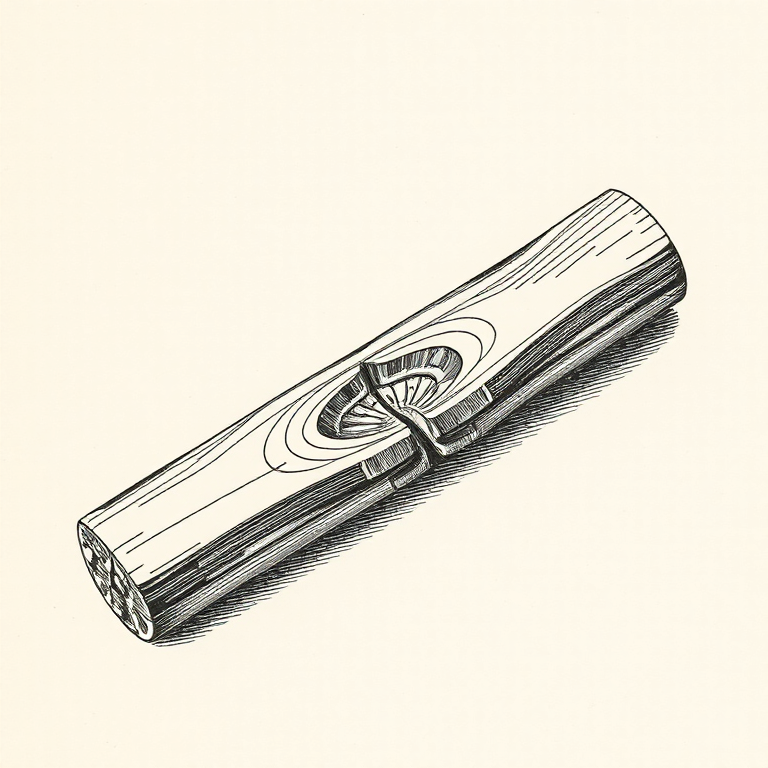
Tally sticks were the dominant financial instrument in medieval England for centuries. A stick of wood (usually hazelwood) was notched to indicate a sum, then split lengthwise. The creditor kept the longer piece (the “stock,” the origin of the term “stockholder”) and the debtor kept the shorter piece (the “foil”). The two halves’ wood grain had to match when reunited, making forgery nearly impossible. The Exchequer used tally sticks as receipts for tax payments, and the stocks circulated as money: if the Crown owed you money, you could use the tally stick to pay someone else, because they could present it to the Crown later.
The system was so embedded in English finance that Parliament didn’t abolish it until 1826. And then, in 1834, someone decided to burn the accumulated pile of old tally sticks in a furnace beneath the House of Lords. The fire got out of control and burned down the Palace of Westminster. Charles Barry’s current building, the one with Big Ben, was built to replace it. A thousand years of financial technology, destroyed by a bonfire that destroyed the building it was housed in.
Cowrie shells served as money across large parts of Africa, South Asia, and East Asia for millennia. The shells came primarily from the Maldives, and their durability, portability, and difficulty to counterfeit made them practical tokens. But again: the shells themselves had no intrinsic value. They worked because people agreed they worked. When the Portuguese and later the Dutch flooded West African economies with imported cowries, the result was inflation: the shells didn’t become worthless, but their value dropped, because the supply increased faster than the economies that used them.
Coins, and the state enters the picture
Metal coins emerged around the 7th century BCE, roughly simultaneously in three separate places: Lydia (modern western Turkey), China, and India. The Lydian coins, made of electrum (a natural gold-silver alloy), are the best documented. King Alyattes and later his son Croesus (whose name gave us the phrase “rich as Croesus”) stamped coins with a royal seal, and that seal changed everything.
The stamp said: the state guarantees this metal is what it says it is. You don’t need to weigh it or test its purity yourself. The state has done that for you. Trust the stamp.
This is chartalism: the theory, developed by the German economist Georg Friedrich Knapp in The State Theory of Money (1905), that money derives its value from the state’s authority, particularly from the state’s power to demand taxes. If the state says “you owe us taxes, payable in these coins,” then everyone needs the coins, which means everyone will accept them in trade, which means they function as money. The state doesn’t just use money; the state creates the demand for money.
Knapp’s insight explains a lot. Roman coins circulated across an enormous empire not because everyone loved silver but because Rome demanded taxes in those coins. When Rome fell and the tax system collapsed, the coins’ value collapsed too, not because the silver disappeared, but because the authority behind the stamp did.
Paper, banks, and the promise
Paper money started as receipts. In Song Dynasty China (around the 10th century), merchants deposited copper coins with trusted agents and received paper certificates in return. The certificates were easier to carry than sacks of coins, so people started trading the certificates instead of the coins. The government noticed, took over the system, and started issuing jiaozi, the world’s first government-issued paper currency, around 1024 CE.
The same pattern repeated independently in Europe centuries later. Goldsmiths in 17th-century London accepted gold deposits and issued receipts. The receipts circulated as money. The goldsmiths noticed that not everyone came back for their gold at the same time, so they started issuing more receipts than they had gold. This was the birth of fractional reserve banking: the goldsmiths were creating money out of thin air, backed by the reasonable bet that everyone wouldn’t show up at once.
When everyone did show up at once, you got a bank run. The goldsmith couldn’t honour all the receipts. Depositors lost their money. This happened often enough that governments eventually stepped in to regulate the process and create central banks as lenders of last resort: institutions that could print money to bail out banks that were otherwise solvent but temporarily short of cash. The Bank of England was founded in 1694 specifically to lend money to a government that had run out of it (William III needed to fund a war against France, naturally).
The critical point is this: banks create money when they make loans. This isn’t a conspiracy theory; it’s the mechanical reality of how modern banking works, and the Bank of England explained it plainly in a 2014 quarterly bulletin titled “Money Creation in the Modern Economy.” When a bank approves your mortgage, it doesn’t go to a vault, take out someone else’s savings, and hand them to you. It creates a new deposit in your account; literally types a number into a computer. That number is new money. It didn’t exist before the loan was made. The money supply just increased.
The loan is simultaneously an asset for the bank (you owe them money) and a liability (they owe you a deposit). The two sides balance. When you repay the loan, the money is destroyed; the process runs in reverse. Money is constantly being created and destroyed by the banking system, and the amount in existence at any given moment is a function of how much lending is happening.
The gold standard and why we left it
For a long time, paper money was theoretically backed by gold. If you had a dollar, you could, in principle, walk into a bank and demand a dollar’s worth of gold. This was the gold standard, and it provided a kind of anchor: the money supply couldn’t grow faster than the gold supply.
The classical gold standard ran from roughly the 1870s to 1914. Britain had been on a de facto gold standard since Isaac Newton, as Master of the Mint, set the gold price in 1717 (yes, that Newton). Other countries followed: Germany in 1871, the United States in 1879, Japan in 1897. The system created remarkable exchange-rate stability. If you knew the gold content of a British pound and the gold content of a French franc, you knew the exchange rate between them. International trade was simpler.
The problem was that the gold standard was brutally inflexible. If your economy was growing but the gold supply wasn’t, you got deflation: falling prices, rising real debt burdens, recession. If a country ran a trade deficit, gold flowed out, the money supply contracted, and the economy suffered until wages and prices fell enough to restore competitiveness. This “adjustment” was theoretically elegant and practically devastating. It meant that economic policy was subordinated to an arbitrary metal. As the economist Barry Eichengreen argued in Golden Fetters (1992), the gold standard was a major reason the Great Depression was so deep and so widespread; countries that left gold earlier recovered faster.
World War I killed the classical gold standard. Governments needed to spend far more than their gold reserves allowed, so they suspended convertibility and printed money. After the war, there were attempts to return to gold, most famously Britain’s disastrous return at the pre-war parity in 1925, a decision made by Winston Churchill as Chancellor of the Exchequer, which John Maynard Keynes attacked in a pamphlet called The Economic Consequences of Mr. Churchill. The overvalued pound crushed British exports and contributed to the General Strike of 1926.
The system that replaced the classical gold standard after World War II was the Bretton Woods system (1944-1971). The US dollar was pegged to gold at USD$35 per ounce, and other currencies were pegged to the dollar. This meant the dollar was effectively the world’s reserve currency, and the US was supposed to hold enough gold to back all the dollars in circulation.
By the late 1960s, this was clearly impossible. The US had been spending heavily on Vietnam and domestic programs, and the dollars in circulation far exceeded the gold in Fort Knox. Foreign governments started demanding gold for their dollars, and the reserves were draining fast. On 15 August 1971, President Nixon announced that the US would no longer convert dollars to gold. This was the “Nixon Shock,” and it ended the last formal link between money and any physical commodity.
Since 1971, all major currencies have been fiat money: money by government decree, backed by nothing except the issuing government’s authority and the collective agreement of everyone who uses it. The word “fiat” comes from the Latin for “let it be done.” The government says this is money. We agree. It works.
MMT and Austrian economics: two stories about what comes next
If money is just a ledger entry backed by government authority, two big questions follow. How much money can the government create? And what constrains it?
Modern Monetary Theory (MMT) says: a government that issues its own currency can never run out of money. It can always create more. The US government can’t go bankrupt in dollars for the same reason a scorekeeper can’t run out of points: they’re the ones keeping score. The real constraint isn’t money; it’s resources. If the government creates too much money and there aren’t enough goods and services to absorb it, you get inflation. So the limit on government spending isn’t the budget; it’s the economy’s productive capacity.
The key figures are Warren Mosler (a hedge fund manager who developed the framework from his experience in bond markets), L. Randall Wray, and Stephanie Kelton, whose book The Deficit Myth (2020) brought MMT to a popular audience. The theory implies that taxes don’t fund government spending; the government creates money when it spends and destroys money when it taxes. The purpose of taxation is to create demand for the currency and to manage inflation, not to raise revenue.
This is genuinely counterintuitive. It means the question “how will we pay for it?” is the wrong question. The correct question is “do we have the real resources (the workers, the materials, the capacity) to do this without overheating the economy?”
Austrian economics takes the opposite view. The Austrian school (Ludwig von Mises, Friedrich Hayek, Murray Rothbard) argues that money should be hard to create. In the Austrian view, money is best when it’s a commodity (or backed by one), because commodity money constrains governments from inflating the currency. When governments can print money at will, they inevitably print too much, debasing the currency and redistributing wealth from savers to borrowers. Inflation is, in Rothbard’s phrase, “legalized counterfeiting.”
Hayek went further. In Denationalisation of Money (1976), he proposed that governments shouldn’t have a monopoly on currency at all. Private institutions should be free to issue competing currencies, and the market would sort out which ones were trustworthy. Bad money would be refused; good money would circulate. This was a radical idea in 1976 and a prophetic one; it reads like a description of the cryptocurrency ecosystem that arrived thirty years later.
The MMT-Austrian debate isn’t just academic; it’s about the fundamental question of political economy. Who should control money, and how much of it should exist? MMT says sovereign governments should spend freely up to the limit of real resources. Austrians say governments should be constrained by something external (gold, a commodity basket, a constitutional rule) because they can’t be trusted with the printing press. The empirical evidence is mixed, which is why the argument hasn’t been settled.
Japan is the MMT case study: government debt exceeding 250% of GDP, decades of deficit spending, and yet no hyperinflation. Interest rates near zero. Prices remarkably stable (until recently). If the Austrian theory were correct (that high debt leads to inflation and currency collapse) Japan should have imploded years ago. It hasn’t. On the other hand, Turkey and Argentina show what happens when governments create money recklessly in economies without Japan’s institutional credibility: currency collapse, soaring prices, and real hardship for ordinary people.
The honest answer is that both frameworks capture something true. Money is a social technology that depends on trust, and that trust has limits. Where exactly those limits are depends on institutions, productivity, history, and luck. There’s no formula.
So what is money?
Money is a ledger. It’s a record of who owes what to whom, maintained by a combination of social agreement, institutional authority, and, increasingly, software. The physical tokens change (shells, sticks, coins, paper, pixels) but the underlying function doesn’t: money is a system for tracking obligations across time and distance.
It works because we agree it works. That agreement is remarkably durable: people will accept money from governments they don’t trust, in countries they’ve never visited, denominated in currencies they don’t understand. The agreement is also remarkably fragile: hyperinflation in Weimar Germany, Zimbabwe, and Venezuela showed how quickly a currency can collapse when the agreement breaks down.
Every time you tap your card at a coffee shop, you’re participating in a system that started with social memory in small communities, evolved through cowrie shells and tally sticks and gold coins, survived the collapse of empires and the abandonment of the gold standard, and now runs on computers that create money from nothing every time a bank approves a loan. It’s one of humanity’s most extraordinary inventions, and most of us never think about it.
But tapping your card is only the beginning of the story. What actually happens when you tap? Where does the money go? How does it get from your bank to the coffee shop’s bank? And why does it sometimes take three days?
That’s what How Payments Work is about: the plumbing beneath every transaction.