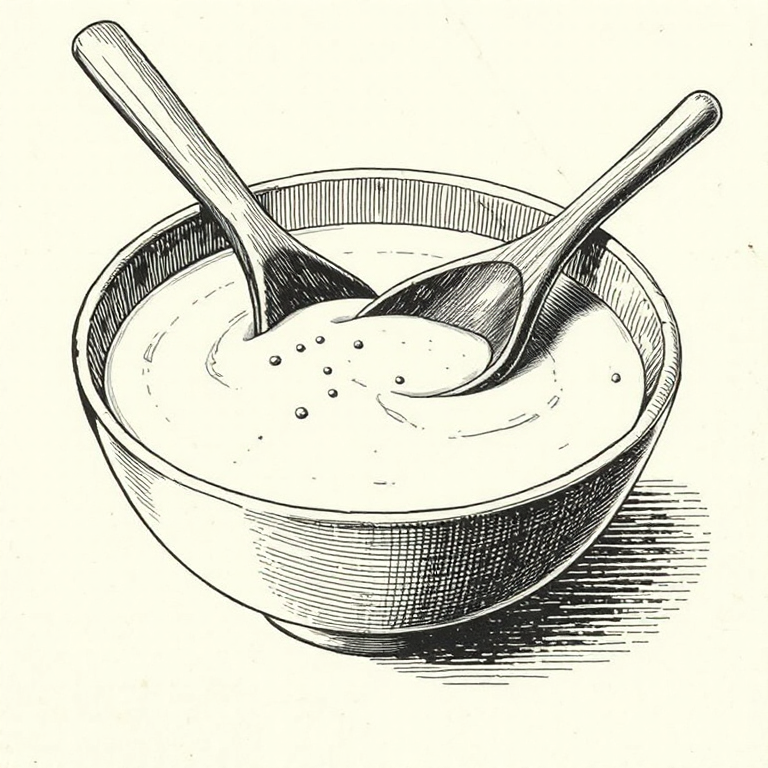
Pastry cream is custard with a backbone. The cornflour stops the eggs scrambling and gives the mix a thick set that holds its shape under pastry without weeping. Once you can make it, an enormous amount of pâtisserie opens up – the same cream, piped or spread or folded or layered, sits inside éclairs, choux buns, fruit tarts, religieuses, Saint-Honoré, and the mille-feuille this one’s headed for.
Ingredients (makes about 600g)
- 500ml whole milk
- 1 vanilla pod, split and scraped (or 2 tsp vanilla bean paste)
- 5 large egg yolks
- 100g caster sugar
- 50g cornflour
- 30g cold unsalted butter, cubed
You’ll need a medium saucepan, a heatproof bowl, a balloon whisk, a fine sieve, and cling film. A probe thermometer is useful but not essential – the cream tells you when it’s done.
The cook
I pour the 500ml milk into the saucepan with the split vanilla pod and its scraped seeds, and warm it slowly to just below a simmer – small bubbles around the edge, no rolling boil. Off the heat, lid on, let it infuse for ten minutes. The vanilla wants the heat and the time; a quick warm-and-go doesn’t extract much.
While the milk infuses I whisk the 5 yolks and 100g sugar in a heatproof bowl until pale and ribbon stageWhen whisked sugar and egg yolks thicken enough to fall back on themselves in a slow trailing ribbon that holds its shape for a few seconds before sinking. , then whisk in the 50g cornflour until the mixture is smooth – no lumps. The cornflour is the difference between custard and pastry cream; whisk it in cold so it dissolves. 50g per 500ml is the firm end of the French ratio – enough to hold a pipe rather than flow off the spoon.
I bring the infused milk back to just under a simmer, then pour the lot through a fine sieve straight into the egg-yolk mixture in one go, whisking hard. The sieve catches the vanilla pod in the same move, and the cornflour-protected yolks take the full pour without scrambling. The temperWarming whisked eggs or yolks gently with a hot liquid before adding them to the pot, so the proteins don’t scramble from the shock. mix goes back into the saucepan, I switch to a wooden spoon, and bring it up over a medium heat, stirring constantly, scraping the corners of the pan.
The mix thickens suddenly around 80°C – the cornflour swells and grabs everything at once. Don’t stop there. Thickening isn’t the finish line; it’s the halfway point. Keep stirring and bring the cream all the way to a proper boil, then let it bubble hard for a full minute – thick, slow, lava-style bloops breaking the surface. That’s where the starch fully gelatinises and the cream sets firm enough to pipe. Pull it off at first-thicken and you get a gorgeous custard that flows when you scoop it – delicious as a sauce, useless in a piping bag. By feel: it should plop heavily off the spoon and a track drawn through it should hold for a count of three before closing. With a probe: 94-96°C, held for a clean minute.
Off the heat, I beat in the 30g cold butter cube by cube until glossy. The butter drops the temperature and gives the cream its final shine. Straight into a clean bowl, cling film pressed against the surface (touching the cream, not floating above), and into the fridge to set. Minimum two hours; overnight is best.
Loosening it smooth
Pastry cream sets firm in the fridge – almost a panna-cotta wobble. Before piping or spreading, scrape the chilled cream into a bowl and stir for ten seconds with a spatula (or a balloon whisk) until it loosens into a glossy, spoonable cream. Stop the moment it’s smooth. Starch-thickened cream is a mechanical gel – keep working it and you shear the gel structure past where it can re-knit, and a firm cream turns to liquid that won’t come back.
If you’re spooning rather than piping, you can skip this step entirely – a confident dollop straight from the fridge looks intentional. The loosening is for piping cleanly through a nozzle.
If the cream is going under a fruit tart shell that wants the absolute glossiest finish, fold in a splash of double cream once it’s loosened – the dairy fat smooths everything out.
Storing
Pastry cream keeps three days in the fridge, covered. Don’t freeze it – the cornflour goes grainy on defrost and the eggs weep. Make on the day or the day before; that’s the cost of a custard-based cream.
If the cream weeps a little in the fridge (a thin layer of liquid on top), just whisk it back in. If it sets soft enough to flow when scooped, the starch didn’t fully gelatinise – next time, push past first-thicken and hold a full minute of hard boil.
Variants
- Chocolate pâtissière (crème pâtissière au chocolat): whisk 100g dark chocolate, chopped, into the hot cream off the heat, before the butter.
- Coffee pâtissière: dissolve 2 tbsp instant espresso into the warm milk, or infuse 20g whole coffee beans during the vanilla step and strain.
- Praline pâtissière: fold 80g praline paste into the cooled cream before whisking smooth.
- Lighter pastry cream (crème diplomate): fold 200ml of whipped double cream through the loosened pastry cream just before using. Softer mouthfeel, lighter under pastry, especially good in mille-feuille if you want more cloud and less custard.
Where the cream goes
- The mille-feuille aux framboises – piped between layers of rough puff
- Inside choux buns, éclairs, religieuses, Paris-Brest
- Under fresh strawberries, raspberries, or grapes in a blind-baked tart shell
- Folded with whipped cream into a Saint-Honoré
- Spooned into a trifle in place of the custard layer
- Sandwiched between sponge halves for a more pâtissière-style Victoria