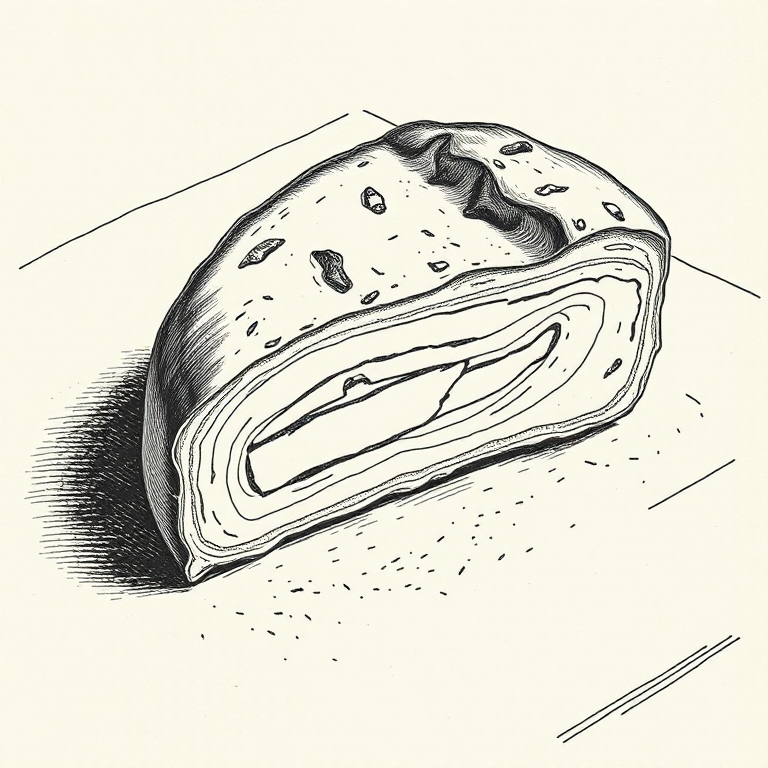
Classic puff pastry asks for a slab of butter folded and turned and rested through most of a day. Rough puff cheats. The butter goes in as cubes, rolled flat by the pin, lengthened by the turns. The layers are less even than the laminated kind, which is exactly what you want when you’re going to slice the bake into rectangles and stack them with cream – shaggy puff catches and holds.
Ingredients (one large rectangle, about 600g)
- 250g plain flour (target around 11% protein – T55 if you have it, or blend a low-protein cake flour with a high-protein bread flour to land near 11%)
- 5g fine salt
- 250g cold unsalted butter, cubed into 1cm pieces
- 125ml ice-cold water
- 1 teaspoon lemon juice or white vinegar
You’ll need a rolling pin, a clean bench, a bench scraper, cling film, and a fridge with at least three hours free across the afternoon. Don’t try to do this in a hot kitchen – the butter needs to stay cold.
The method
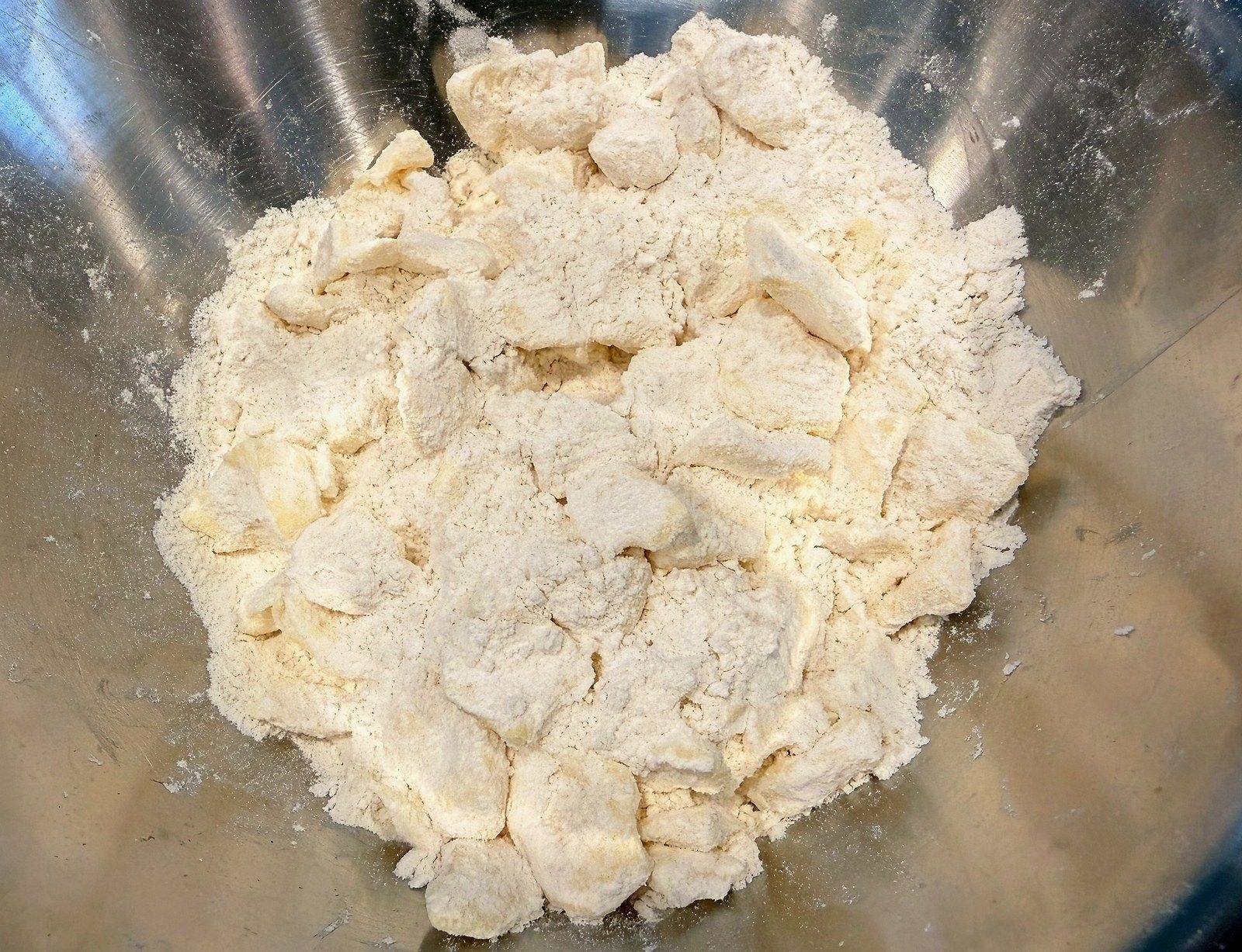
I weigh the 250g flour and 5g salt into a wide bowl and tip in the 250g cubed butter. I toss the cubes through the flour with my fingertips so every face is coated, then press each cube flat between thumb and forefinger – a quick squash, not a rub. The cubes go from dice to flat flakes the size of a fifty-cent piece, still distinct, still cold. This is the whole trick. Classic puff uses a single butter block; rough puff uses a thousand small ones, and the flakes do the same job once they roll out.
I mix the 125ml ice water with the 1 tsp lemon juice and pour it in, working it through with a bench scraper until the dough just holds. It’ll look shaggy and dry in patches – that’s right. A wetter dough is harder to turn. I gather it onto the bench, press it into a rough rectangle, wrap, and into the fridge for thirty minutes.
The turns
Four turns total: two turns, fridge, two turns, fridge. That’s the whole shape. One turn is a letter foldFolding a rolled-out laminated dough in thirds, bottom-up and top-down like a letter into an envelope – one turn, multiplying the layer count by three. : roll the dough out long, fold the bottom third up, fold the top third down (like a letter into an envelope), rotate 90 degrees. The rotate is part of the turn, not a separate step.
Four turns gives 81 layers, which is the rough-puff number. Classic puff gets six (729 layers); the extra two turns build counts that get lost in rough puff anyway. Past six and the butter merges into the dough and you lose flake altogether – so if you lose count partway through, stop. Four is the target, five is fine, six is the absolute ceiling. Don’t be tempted to add more.
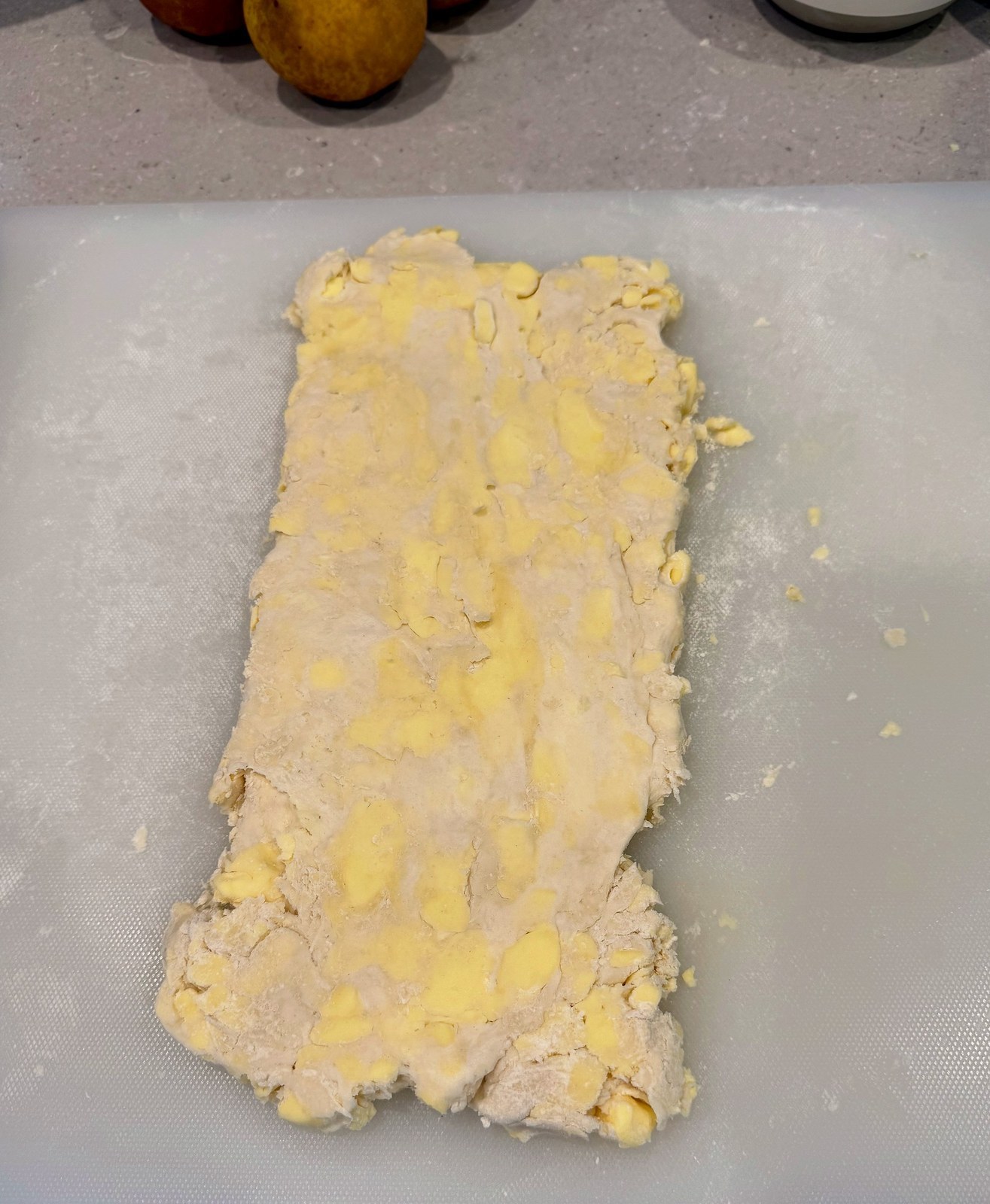
Turn one. I roll the chilled dough on a lightly floured bench into a long rectangle, roughly 20cm by 50cm, the short edge facing me. Don’t worry about ragged edges or the odd butter flake escaping – patch with a smear of flour and keep rolling. I fold the bottom third up and the top third down like a letter into an envelope, then rotate the folded block 90 degrees so the folded edges sit on my left and right and the open layered edges face me and away. That puts the seams perpendicular to the next roll, so the pin lengthens the layers instead of sliding them.
Turn two. Roll out long again, fold bottom third up, fold top third down, rotate 90 degrees. Wrap and back to the fridge for thirty minutes.
Turn three. Out of the fridge. Roll long, fold bottom up, fold top down, rotate 90 degrees.
Turn four. Roll long again, fold bottom up, fold top down, rotate 90 degrees. Wrap.
The dough firms up between rests and rolls out more cleanly each time; by turn four the butter has disappeared into thin sheets between thin sheets of dough.
Rest the wrapped block for at least one more hour before use – overnight is better. The pastry needs that final rest as much as the turns; without it the gluten fights back and the layers contract in the oven.
Rolling and baking
Roll the rested block on lightly floured parchment to the thickness the recipe wants – 3mm is common for layered bakes, a touch thicker for vol-au-vents – and chill on the paper for fifteen minutes once it’s at thickness so the gluten settles. Cold dough into a hot oven: 200°C is the workhorse temperature. Dock the surface with a fork for flat slabs that stack; leave it un-docked for full puff. For free puff – palmiers, jalousies, vol-au-vents – brush with egg wash and bake until deeply golden.
Storage
The block keeps in the fridge for three days and freezes for three months. Defrost overnight in the fridge before rolling. Don’t refreeze after rolling out.
Where the pastry goes
- The mille-feuille aux framboises – its showcase job, baked flat between trays
- Palmiers – sugared, rolled into double scrolls, sliced and baked
- Cheese twists, sausage rolls, vol-au-vents
- A jalousie or pithivier with frangipane and stone fruit
- Tarte fine: rolled thin, topped with sliced apple or pear, baked free
- A lid for any pie that wants something fancier than shortcrust