Poaching is the gentlest way to cook a pear. The fruit goes in firm and comes out yielding-but-intact, scented with vanilla and lemon and whatever else went into the pan. The trick isn’t the simmer – thirty minutes at a bare bubble does it – but the cool-down: the pears need to sit in the syrup off the heat for hours, ideally overnight, while the flavour migrates from the surface to the core. A hot poach and a quick drain barely flavours the skin.
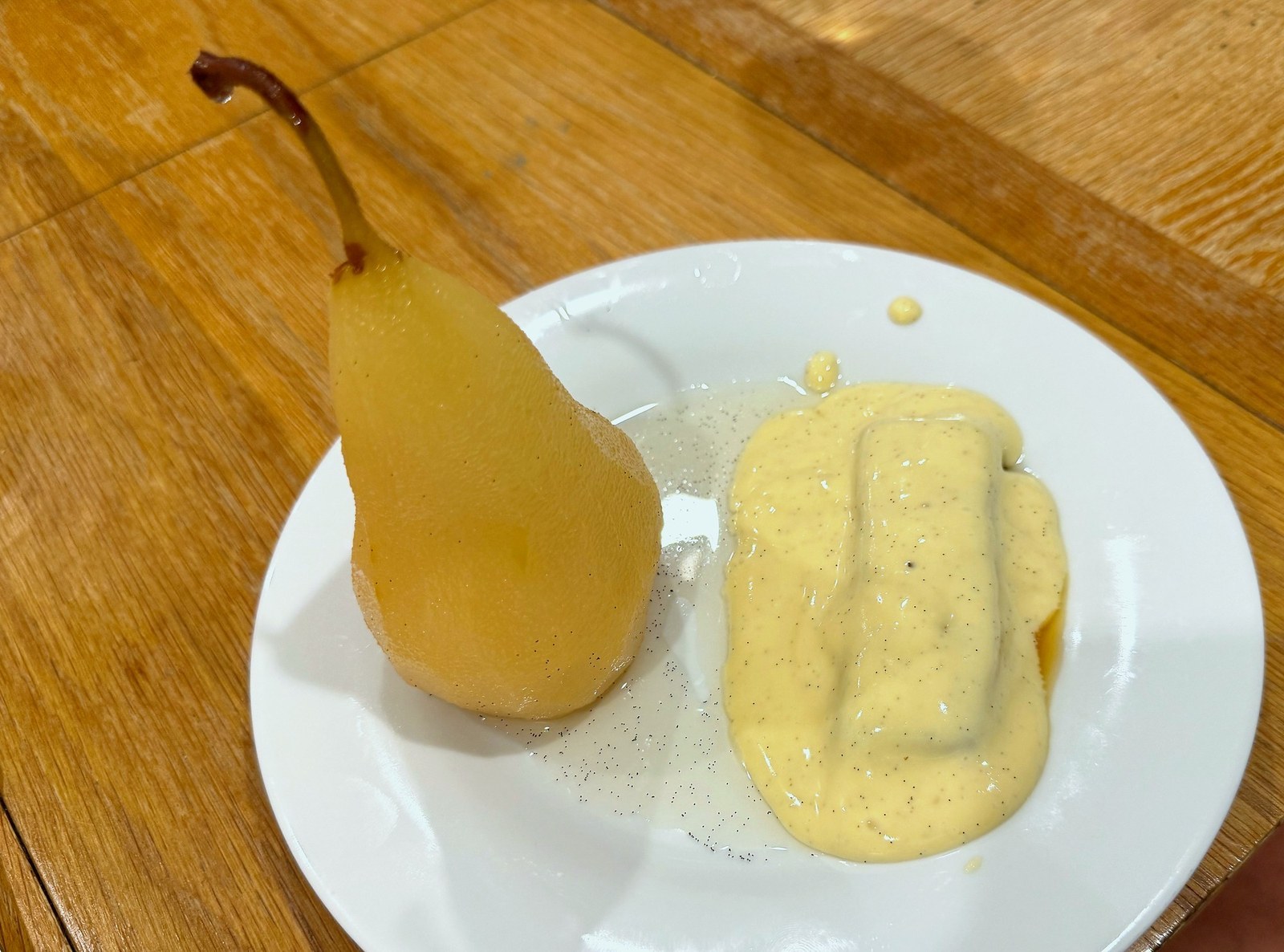
Why Beurre Bosc
May in Perth is pear season, and the produce shelves hold Beurre Bosc and Packham side by side. Beurre Bosc holds its shape through a thirty-minute poach where a riper Packham can soften into the syrup.
Packham works – it’s the round green one most Australian supermarkets stock by default – but ripens faster and wants fifteen minutes in the syrup, not thirty. If both are on the shelf, Bosc.
Ingredients (1 whole pear – scale up as needed)
- 1 firm Beurre Bosc pear (or Packham, taken off the bench slightly under-ripe)
- 125ml water
- 60g caster sugar
- 1 vanilla pod, split lengthwise (or 2 tsp vanilla bean paste)
- 1 thin strip lemon peel, pith trimmed
- A few drops of lemon juice
- 1 small cinnamon stick (optional)
- 1 star anise (optional)
Multiply everything by the number of pears you want, with the vanilla as the only odd one out: one pod per two pears, give or take, since pods don’t divide neatly and a generous hand here is no bad thing. Four pears needs 500ml water, 250g caster sugar, 2 vanilla pods, a generous strip of peel, and a teaspoon of juice.
You’ll need a saucepan deep enough to hold the pear (or pears) upright and snug – a milk pan for one, a small wide saucepan for two to four – a small plate or saucer that fits inside the pan to weigh the fruit down, and overnight fridge space.
The cook
I peel the pear with a vegetable peeler, leaving the stalk on for shape and grip. I core it from the bottom with a melon baller or the tip of a small paring knife, taking the seeds and the woody core, stopping just short of the stalk so the pear stays whole. The cored cavity is what lets the syrup get inside; a solid pear flavours only at the skin.
I drop the peeled pear straight into a bowl of cold water with a squeeze of lemon while I work on the syrup (and on any other pears, if scaling up). Pear flesh oxidises and browns within minutes once peeled, and the acid stops it cold.
The syrup goes into the saucepan: water, sugar, the split vanilla pod and its scraped seeds, the strip of lemon peel, the squeeze of juice, and any spices you’re using. I bring it to a low simmer and stir to dissolve the sugar – a minute or two – then lift the pear out of its lemon water and lower it in. The syrup won’t reach the shoulders – in a snug pot it covers the lower half and not much more – and that’s fine. Topping up to drown the fruit dilutes the syrup more than it helps; a small plate on top to hold it down and a quarter-turn every five or ten minutes handles the exposed half.
Lay the small plate over the pear – something that fits inside the pan and rests on the fruit, weighing it down so it doesn’t bob. Lid off, heat low, a bare simmer – small bubbles around the edge, not a rolling boil. A rolling boil bruises the pear and clouds the syrup. Lift the plate every five or ten minutes and turn the pear a quarter so a new face goes under.
Twenty to thirty minutes for Beurre Bosc, fifteen for Packham. It’s ready when the tip of a small knife slides into the thickest part with no resistance, like cutting butter.
Off the heat, lid on, leave the pear in the syrup. Cool on the bench for an hour, then into the fridge overnight in the saucepan or transferred to a bowl with the plate still weighing it down. The overnight rest is half the recipe.
Storing
In its syrup in a sealed container in the fridge, a poached pear keeps five days. The flavour deepens for the first two – the vanilla and the lemon push further in – then plateaus. The syrup itself, strained, keeps two weeks; reduce it by half on the stove if you want a thicker glaze for plating.
Don’t freeze poached pears. The cell walls take a beating in the freeze-thaw and the texture goes from yielding to spongy.